Executive summary
- The European Parliament and EU governments held their first political round of talks on 20 October on extending the carbon border adjustment mechanism (CBAM) to downstream steel and aluminium goods. They set out their positions and sent several points back to technical work. The next round is on 30 November.
- The three institutions start far apart on scope. The Commission proposed adding 180 products from 1 January 2028; EU governments back a list of about 200; Parliament wants 457.
- Steel and downstream associations, including EUROFER and the distributors’ body EUROMETAL, and the industriAll union have asked negotiators for the “broadest possible” list.
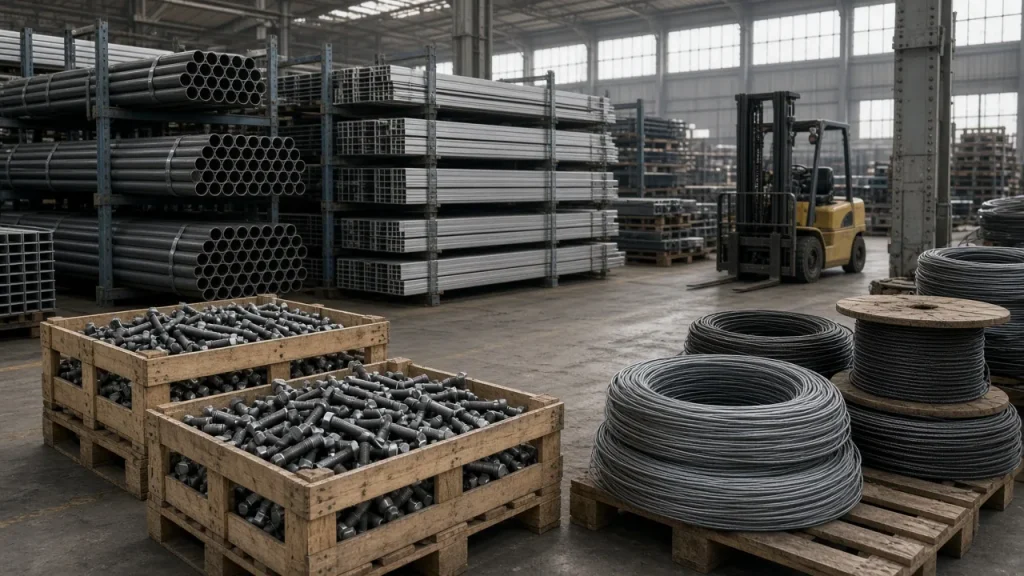
- For buyers, the length of the final list decides whether imported fasteners, wire, tubes and other fabricated steel goods start carrying a carbon cost from 2028, and so how much of that work stays with EU fabricators using EU or CBAM-paid steel. Nothing is law yet.
Key numbers
180 Downstream steel and aluminium products the Commission proposed to add to CBAM from 1 January 2028 FactEuropean Commission, 17 Dec 2025
79% Average steel and aluminium content of those products; 94% are industrial supply-chain goods FactEuropean Commission
≈ 200 Products in the Council’s position of 12 June 2026, as summarised by Parliament’s research service FactEPRS
457 Products in Parliament’s position, adopted on 15 September 2026 by 464 votes to 50, with 159 abstentions FactEuropean Parliament and Legislative Train
30 Nov Date of the next political round of talks, as reported FactAgence Europe and Publicea
Fact = supported by the cited primary source or clearly attributed reporting/market assessment · Calc. = Loharo calculation from cited figures · Uncertain = an attributed claim not independently confirmed · Analysis = interpretation or forecast with sourced premises.
What happened
CBAM has applied to imports of iron and steel, aluminium, cement, fertilisers, electricity and hydrogen since 1 January 2026, but it covers almost only basic materials. In December 2025 the Commission proposed to close that gap. Its proposal would add 180 steel- and aluminium-intensive downstream products from 1 January 2028. According to the Commission, 94% of them are industrial supply-chain goods, such as cylinders, industrial radiators, casting machines and base metal mountings, with on average 79% steel or aluminium content; the other 6% are household goods. The proposal would also treat pre-consumer metal scrap as a precursor, add anti-circumvention rules, and let the Commission take a good out of CBAM in serious and unforeseen circumstances, as its questions and answers and the Parliament research service describe.
EU governments agreed their position on 12 June 2026. According to the Parliament research service, it widens the list to about 200 goods and asks the Commission to review further downstream products every year from 2028. Parliament adopted its own position on 15 September by 464 votes to 50, with 159 abstentions, and went much further: its committee text lists 457 products. The Parliament press release says MEPs also tightened the anti-circumvention rules and rejected the Commission’s clause for removing goods from CBAM after price shocks, preferring to redirect CBAM revenue to the sectors hit for a limited time.
Reach steel buyers and importers worldwide
Put your brand in front of the people who buy and trade steel.
Advertise with LoharoThe first political round of talks between the two took place on 20 October. Agence Europe reported that the institutions set out their positions and left four points for officials to work through: a de minimis threshold for aluminium goods, how metal waste is handled, whether online platforms are covered, and default values set at global level. Its headline says the talks “raise no major issues”. The consultancy Publicea gives the same account and the same next date, 30 November. Agence Europe put the Council’s list at 400 products, which does not match the figure of about 200 in Parliament’s research note and a Mayer Brown comparison; we use the lower figure and flag the difference.
On scrap, the positions differ in detail. According to Mayer Brown, the Council follows the Commission in treating pre-consumer steel and aluminium scrap as a precursor and leaving post-consumer scrap out, while Parliament would require emissions from pre-consumer steel scrap to be reported without counting them towards embedded emissions. These points rest on the law firm’s reading of the mandates, which we could not check against the full texts.
Ahead of the talks, a group of associations that includes EUROFER, EUROMETAL, the European Steel Tube Association, the wire rod processors’ body EUNIRPA, European Aluminium and the industriAll European trade union issued a joint statement, reported by EUROMETAL. It asks the institutions to agree “the broadest possible” extension, warning that products left outside CBAM risk being replaced by imports or moved abroad as free ETS allowances are phased out.
Why it matters for steel buyers
Analysis CBAM already adds a carbon cost to imported coil, plate, wire rod and tube (see our worked example and the Q3 certificate price). A fabricated article made abroad from the same steel, such as a bolt, spring, wire rope or welded tube assembly, currently enters with no CBAM charge. That gap grows as EU mills lose free allowances, and it is the gap the downstream extension is meant to close.
Analysis The list matters more than the principle. Under the Commission’s 180 products, most of the coverage is industrial components. Under Parliament’s 457, many more finished and semi-finished goods would carry a carbon cost from 2028. For EU fabricators, re-rollers and distributors, a longer list means less competition from imported finished goods and more reason to buy EU or CBAM-paid steel. For companies that import metal-intensive components, it means new declarations, emissions data from suppliers and a higher landed cost.
Analysis The scrap treatment is a smaller but practical point. If pre-consumer scrap counts as a precursor, importers of CBAM goods made from factory offcuts will need suppliers to document the scrap share and its origin. It is a separate question from the EU’s planned waste export list, which governs where scrap may be shipped.
Analysis None of this is final. The product list, the scrap rules and the crisis clause can all change before a deal, and a final text still needs formal adoption by both institutions.
Who is affected
- Importers of fabricated steel and aluminium goods (fasteners, wire and wire products, tubes and fittings, machinery parts): they could become CBAM declarants for these goods from 2028.
- EU fabricators, wire drawers, tube makers and distributors: a broader list would narrow the cost gap with imported finished goods.
- Buyers of EU coil, wire rod and tube: more downstream demand could stay in the EU, supporting mill order books.
- Scrap suppliers to EU mills and remelters: may be asked to show whether scrap is pre-consumer or post-consumer.
Stay ahead of the steel market
What to watch
- 30 November: the next political round of talks, and whether a provisional deal follows before the end of the year.
- The final product list: where it lands between 180 and 457 goods, and which CN codes for wire, fasteners, tubes and structures are in.
- The crisis clause: whether the Commission keeps the power to exempt goods after price shocks, or Parliament’s revenue-redirection model prevails.
- Scrap and default values: how pre-consumer scrap is treated, and whether default values are set at global or country level.
Verification status: Verified
- Material factual claims are supported by appropriate primary sources or clearly attributed reporting and market assessments; Loharo analysis is labelled separately. Last fact-check: 24 October 2026.
- Key: Verified = material factual claims are supported by an appropriate primary source or clearly attributed reporting/market assessments; Partially verified = a specific material claim remains unsupported, contradicted or materially overstated; Analysis = interpretation or forecast with sourced premises; Developing = material facts are checked but the situation is still changing.
Ask the Analyst
“1,500 t HRC from India into Felixstowe at €600/t CFR”: landed cost with duty, quota and CBAM in one answer.Ask the AnalystSources
Primary sources
- Commission strengthens the Carbon Border Adjustment Mechanism — European Commission press release, 17 December 2025
- Questions and answers on the Carbon Border Adjustment Mechanism — European Commission, 17 December 2025
- Strengthening the EU carbon border adjustment mechanism and closing loopholes — European Parliament, September 2026
- Extension of CBAM to downstream goods and anti-circumvention measures — European Parliament Legislative Train Schedule
- Extension of CBAM’s scope to downstream goods and anti-circumvention measures — European Parliamentary Research Service, 2026
- CBAM trilogues: Europe must protect its industrial value chains, investments and quality jobs through a broad scope extension — joint statement of European industry associations and industriAll, October 2026
Supporting sources
- First talks between European Parliament and EU Council on extending Carbon Border Adjustment Mechanism raise no major issues — Agence Europe, 21 October 2026
- CBAM in its definitive phase: what the downstream extension means for importers and manufacturers — Publicea, updated 22 October 2026
- EU’s CBAM downstream extension and anti-circumvention amendments: the road to trilogue — Mayer Brown, 7 October 2026
- European steel and downstream industries call for comprehensive EU CBAM expansion — EUROMETAL, 21 October 2026
Related on Loharo
- How CBAM feeds into the landed cost of imported steel: a worked example
- CBAM Q3 price set at €82.32: what steel importers will owe for 2026 imports, and when the bill lands
- EU draft waste list would shut India, Pakistan and Egypt out of EU steel scrap from May 2027
Last fact-check: 22 October 2026 (Europe/Amsterdam).