Executive summary
- European steelmakers are criticising how the EU shares out its steel tariff quotas when too many cargoes claim them on the same day, according to a 26 October report by EUROMETAL citing sources speaking to Dow Jones Energy (OPIS).
- Under the EU customs rules, claims made on the same day that exceed the quota balance are cut back in proportion. Each cargo gets part of its tonnage duty-free and pays the 50% out-of-quota duty on the rest, so the duty is spread across every claim instead of falling in full on some cargoes.
- EUROMETAL’s example is “other seamless tubes” from China (product category 24): a quarterly quota of 13,159 t against 23,948 t awaiting allocation in a 2 October report by the European Steel Tube Association. That would average out at an estimated 22.53% duty per tonne. The data do not fully confirm that the shared allocation happened.
- Loharo calculation: total duty paid is the same either way (about 10,789 t at 50%), and on the reported offer even the full 50% duty leaves Chinese tubes about €68/t below the reported EU price. In this example the price gap, not the sharing rule, is what keeps imports competitive.
What happened
Since 1 July 2026 the EU has limited steel imports through tariff quotas under Regulation (EU) 2026/1384. Imports within a quota pay no extra duty; imports above it pay a 50% out-of-quota duty. The quotas open each quarter and are allocated first come, first served.
According to EUROMETAL, which reported on 26 October that sources had spoken to Dow Jones Energy, EU steelmakers see the way first-day claims are handled as a weakness that importers can exploit. When the claims made on the day a quota opens exceed the quota, all of them are reduced by the same percentage. EUROMETAL said this means the 50% duty is in effect spread across the whole volume, so excess tonnes enter without each paying the full rate.
Reach steel buyers and importers worldwide
Put your brand in front of the people who buy and trade steel.
Advertise with LoharoThe mechanism is written into the EU customs code. Article 51(4) of Implementing Regulation (EU) 2015/2447 says that where the claims linked to declarations accepted on the same date exceed the remaining balance of a quota, the Commission allocates “on a pro rata basis”. The Commission allocates no earlier than the second working day after a declaration is accepted (Article 51(2)), so an importer learns its share only after clearance.
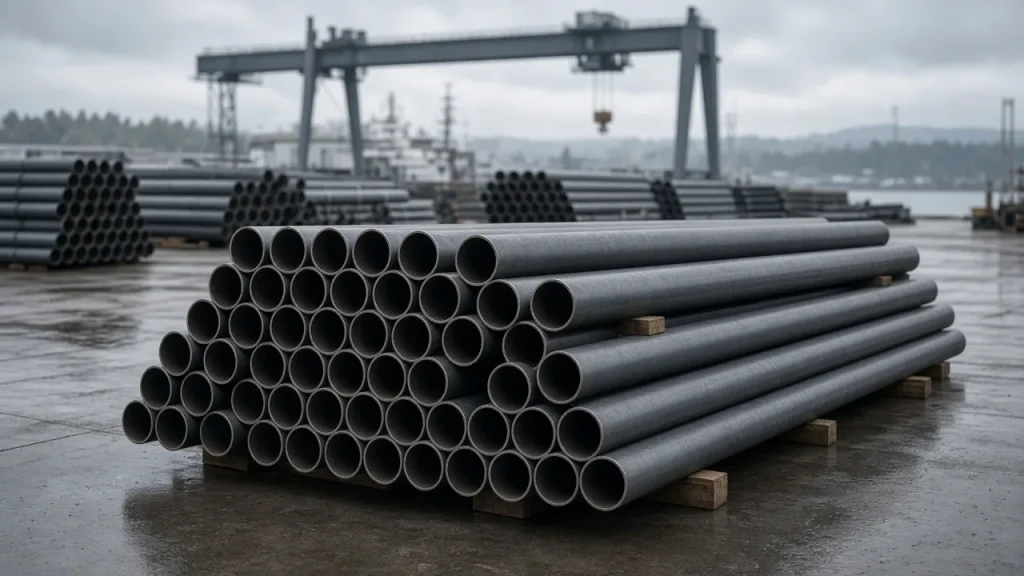
EUROMETAL’s example is product category 24, other seamless tubes, from China. The country’s annual quota is 52,635.36 t, or 13,158.84 t a quarter. A weekly report of 2 October from the European Steel Tube Association (ESTA), cited by EUROMETAL, showed the full balance of 13,159 t still open and 23,948 t awaiting allocation. EUROMETAL said the EU’s TARIC quota tracker showed the quota exhausted, with the last in-scope volumes, dated 8 October, receiving 0% allocation. EUROMETAL noted that ESTA’s data do not show the allocation percentage, so it could not fully confirm that the duty was diluted rather than some claims being withdrawn.
If the 23,948 t were all declared on one day, EUROMETAL calculated an effective duty of 22.53% on every tonne. It reported an import offer from China of €568/t FCA, or €768/t CIF, including a CBAM cost of about €130/t, giving a landed cost of €1,071/t against EU offers of about €1,350/t for similar tubes.
Not everyone agrees there is a loophole. In its Stainless Espresso newsletter of 26 October, published on Steel News, the Gerber Group argued that the shared allocation lets no extra tonne in duty-free: it only averages the duty. It said the Commission had rejected allocation by exact timestamp in 2025 because it could create “considerable legal uncertainty” for EU importers, and that the group proposed to the Commission in October either reserving part of each quota for small and medium-sized importers or capping each importer, counted per corporate group, at 15%. It also called for the Commission to publish aggregated data on who draws the quotas. Importers quoted by EUROMETAL still prefer the pro-rata system to the alternatives, but traders said they cannot see what volume is waiting, because the TARIC tracker shows only the latest allocation.
| First-day claims ÷ quota | Share allocated to each claim | Average duty per tonne | Landed cost at €768/t CIF + €130/t CBAM | Gap to €1,350/t EU offer |
|---|---|---|---|---|
| 1.00 (no excess) | 100% | 0% | €898 | −€452 |
| 1.25 | 80% | 10.0% | €975 | −€375 |
| 1.50 | 67% | 16.7% | €1,026 | −€324 |
| 1.82 (China cat. 24, 2 Oct) | 55% | 22.5% | €1,071 | −€279 |
| 2.00 | 50% | 25.0% | €1,090 | −€260 |
| 3.00 | 33% | 33.3% | €1,154 | −€196 |
| Fully out of quota | 0% | 50.0% | €1,282 | −€68 |
Key numbers
13,159 t China’s quarterly quota for other seamless tubes (category 24) ReportedEUROMETAL, 26 Oct 2026
23,948 t Chinese tonnage awaiting allocation in ESTA’s 2 October report, 1.82 times the quota ReportedEUROMETAL citing ESTA
22.5% estimated average duty per tonne if all claims were shared pro rata, instead of 50% on the excess Calc.EUROMETAL; Loharo check
€4.1m duty on the 10,789 t excess at €768/t CIF: the same total under pro-rata sharing or a strict queue Calc.Loharo calculation
€68/t how far the reported Chinese offer stays below the EU price even with the full 50% duty and €130/t CBAM Calc.Loharo calculation
4 Jan 2027 date on which declarations accepted from 1 to 3 January count as accepted for quota purposes, because 2 and 3 January fall on a weekend FactReg. (EU) 2015/2447, Art. 49(3)
Fact = supported by the cited primary source or clearly attributed reporting/market assessment · Calc. = Loharo calculation from cited figures · Uncertain = an attributed claim not independently confirmed · Analysis = interpretation or forecast with sourced premises.
Why it matters
Analysis Both sides are partly right, and the numbers show where. Pro-rata sharing does not change how much duty is collected. In the category 24 example 10,789 t are above the quota whichever way the quota is shared, and at €768/t CIF the duty on them comes to about €4.1 million. What changes is who pays it. Under pro-rata sharing every first-day importer pays an average 22.5%. Under a strict queue some cargoes would pay nothing and the rest the full 50%. Steelmakers’ concern is that no cargo faces the full deterrent; the Gerber Group’s argument is that the volume entering duty-free is still capped.
Analysis For this product, the sharing rule is not what lets Chinese tubes compete. Loharo’s arithmetic on the offer reported by EUROMETAL gives a landed cost of €1,282/t with the full 50% duty and €130/t CBAM, still about €68/t below the €1,350/t EU offer. EUROMETAL put that gap at almost €100/t; Loharo could not reproduce that figure from the reported numbers. On these figures, the duty would have to exceed about 59% before the offer reached the EU price. Pro-rata sharing raises the importer’s margin (a €279/t gap instead of €68/t), but the price gap exists without it.
Analysis For buyers, the practical point is that a first-day cargo has an uncertain duty bill. The share allocated depends on how many other claims arrive on the same date, and the Commission publishes it only after allocation. A buyer contracting on a DDP or duty-paid basis is exposed to anything from 0% to 50%; one buying CIF and clearing itself carries that risk directly. The more a quota is overbooked, the closer the average gets to 50%: twice the quota means 25%, three times means 33%.
Analysis The January opening may concentrate claims further. Under Article 49(3) of the same customs rules, declarations accepted on 1, 2 or 3 January count as accepted on 3 January, or on 4 January when one of those days is a weekend. In 2027, 2 and 3 January fall on a Saturday and Sunday, so the first quarter’s claims from 1 to 4 January are likely to be shared as one batch. Loharo has not confirmed with the Commission how this applies to the steel quotas; the rule is in the general customs text.
Who is affected
- EU importers and traders of tubes and other quota products: first-day clearances carry a duty share that is unknown until allocation; landed-cost budgets need a range, not a single figure.
- Stockholders and distributors buying duty-paid: contract terms decide who bears an allocation shortfall; check whether the price is fixed or adjusts to the final duty.
- Trade-compliance teams: TARIC shows only the latest allocation, so the effective duty on a past batch has to be recorded at the time.
- Small importers: the Gerber Group’s proposals (a reserve for SMEs or a 15% cap per importer) would change their access if adopted.
- EU tube and pipe producers: in this example the reported import price stays below EU offers even at 50%, so tighter allocation rules alone would not close the gap.
Stay ahead of the steel market
What to watch
- A Commission response to steelmakers’ calls to change first-day allocation, and any data on allocation percentages by quota.
- The 2027 quota allocation act. The current country allocations (Implementing Regulation (EU) 2026/1457) run only to 31 December 2026, so a new act is needed before the first quarter opens.
- The first-quarter opening on 1 January 2027, with declarations from 1 to 4 January likely to count as one date.
- Weekly ESTA quota reports and the TARIC tracker for category 24 and other overbooked categories in the current quarter.
Verification status: Verified
- The allocation rules (Articles 49(3), 51(2) and 51(4) of Implementing Regulation (EU) 2015/2447) are checked against the published text. Steelmakers’ criticism, the category 24 quota and claims, the TARIC status, the import offer, the CBAM cost and the EU price are reported by EUROMETAL citing Dow Jones Energy and ESTA, and are attributed as such; EUROMETAL itself says the data do not fully confirm that duty was diluted. The opposing view and the reform proposals are attributed to the Gerber Group’s Stainless Espresso newsletter on Steel News. The average-duty table, the total duty, the €68/t gap, the 59% break-even and the January batching are Loharo calculations or readings from the cited figures and texts. Last fact-check: 27 October 2026.
- Key: Verified = material factual claims are supported by an appropriate primary source or clearly attributed reporting/market assessments; Partially verified = a specific material claim remains unsupported, contradicted or materially overstated; Analysis = interpretation or forecast with sourced premises; Developing = material facts are checked but the situation is still changing.
Ask the Analyst
“1,000 t HRC from China into Rotterdam at €540/t CFR”: landed cost with duty, quota and CBAM in one answer.Ask the AnalystSources
Primary sources
- Commission Implementing Regulation (EU) 2015/2447 (Union Customs Code implementing rules), Articles 49 and 51 — Official Journal of the EU; article texts: Article 49, Article 51 (legislation.gov.uk, as adopted)
- Regulation (EU) 2026/1384 on the Union steel market (tariff quotas, 50% out-of-quota duty) — Official Journal of the EU, June 2026
Supporting sources
- EU steelmakers take aim at pro-rata TRQ duty dilutions — EUROMETAL (Dow Jones Energy / OPIS; ESTA data), 26 October 2026
- Green Steel: EU Central Planning with a Stamp of Origin (Stainless Espresso, section “Steel Quotas: The Myth of the Diluted Tariff”) — Steel News by Gerber Group, 26 October 2026
Related on Loharo
- EU steel tariff quotas three months in: 50% duty, melt-and-pour proof and a looming Q1 2027 crunch
- Steel trade defence explained: safeguards, anti-dumping, tariff quotas and Section 232
- How CBAM feeds into the landed cost of imported steel: a worked example
- Steel market recap, September 2026: first quota quarter ends, CBAM price rises
Last fact-check: 27 October 2026 (Europe/Amsterdam).