Executive summary
- Grid operator TenneT put a new 380 kV power line to the Salzgitter steelworks into service on 26 October 2026. Salzgitter Flachstahl, the group’s flat-steel arm in Lower Saxony, calls the line a key prerequisite for SALCOS, its programme to replace blast furnaces with hydrogen-ready direct reduction and electric arc furnaces (EAFs).
- The first stage of SALCOS, a direct reduction plant, an EAF and a 100 MW electrolyser, is due to start production in 2027. Salzgitter says it will cut the steelworks’ CO₂ emissions of about 8 million tonnes a year by around 30%.
- Loharo comparison: of the five large EAF projects at European mills we track, three have a stated 2027 start, with about 5.75 million tonnes a year of capacity between them. Salzgitter’s 1.9 million tonnes is the share whose new high-voltage line is now confirmed in service. Port Talbot’s 3 million tonnes depends on a grid link that a Welsh member of the Senedd says faces an estimated 34-week delay.
- For flat-steel buyers planning low-CO₂ volumes for 2027, Salzgitter’s main risks now lie in commissioning the plant and in hydrogen supply, not in the grid. This is a Loharo assessment based on the sources cited.
What happened
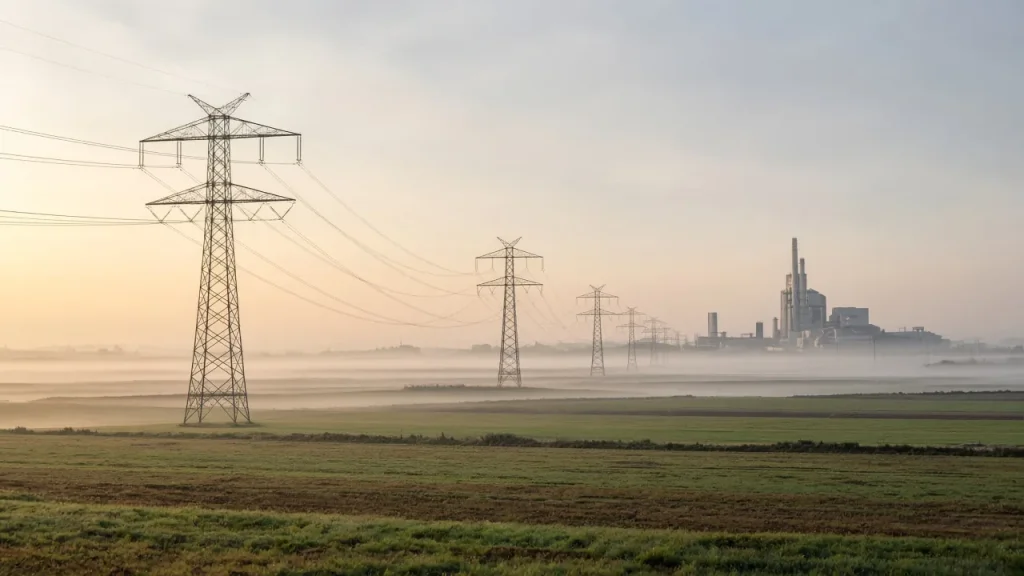
TenneT Germany formally commissioned the Salzgitter industrial power line on Monday 26 October (TenneT, in German; Salzgitter AG, 27 October). The line is a 380 kV overhead line of about 10 km between the Liedingen and Bleckenstedt/Süd substations. At Bleckenstedt/Süd it connects to the regional distribution grid of Avacon. Lower Saxony’s Minister-President Olaf Lies attended the ceremony, along with TenneT Germany chief executive Tim Meyerjürgens and Avacon’s chief executive Matthias Boxberger.
Planning began in May 2021. Work on the substations started in September 2023 and on the overhead line in April 2024, so the project took five years and five months from the start of planning to service; TenneT describes it as about five years. Public broadcaster NDR reports that the line runs on 25 pylons, each 65 metres high, crosses the A39 motorway and stays at least 400 metres from the nearest village (NDR, in German). The line is part of TenneT’s Ostfalen Axis, a grid project area of about 100 km from Mehrum near Peine to the border with Saxony-Anhalt.
Reach steel buyers and importers worldwide
Put your brand in front of the people who buy and trade steel.
Advertise with LoharoSalzgitter says the existing 220 kV grid could not have met the extra demand it expects in the long term. Heike Denecke-Arnold, who chairs the management board of Salzgitter Flachstahl, said the first SALCOS stage is nearing completion and will be finalised next year, when new plants such as the EAF come on stream. Because making steel this way largely means electrifying the process, she called the line “a key infrastructural prerequisite for the success of SALCOS”. Meyerjürgens said the project showed that grid expansion can be done quickly in Germany.
Where SALCOS stage 1 stands
Salzgitter told investors in March 2026 that commissioning was scheduled for the first half of 2027 and that the direct reduction plant had reached its final height of 140 metres (annual press conference presentation). Its September 2026 roadshow presentation gives “2027” for commissioning, says final assembly of the plant equipment at the EAF is under way and puts public funding for SALCOS at €1.322 billion (roadshow presentation). A 2024 company presentation gave the EAF a capacity of 1.9 million tonnes a year and the direct reduction plant 2.1 million tonnes a year (results presentation, March 2024).
Salzgitter has also been securing green power. In September it signed a supply contract with Zelestra for 147 MW of solar capacity, about 158 GWh a year, with battery storage of 79 MW / 237 MWh (Salzgitter, 15 September 2026). On hydrogen, the SALCOS website says the company is building a 100 MW electrolyser at the site and can use up to 150,000 tonnes of hydrogen a year in stage 1 (SALCOS). EUROMETAL, reporting Fastmarkets, wrote in 2025 that the direct reduction plant may initially run on natural gas (EUROMETAL).
The later SALCOS stages are on hold. In September 2025 the supervisory board postponed decisions on stages 2 and 3 by about three years, citing economic and political conditions, according to EUROMETAL. The company still aims to finish the full conversion by the mid-2030s.
How Europe’s big EAF projects compare
Loharo has followed five large EAF projects at European integrated mills this autumn. The table sets out what each company or official record says about capacity, timing and power supply.
| Project | EAF capacity | Stated start | Power and grid status |
|---|---|---|---|
| Salzgitter Flachstahl, Germany (SALCOS stage 1) | 1.9 Mt/y (2024 presentation) | Production in 2027; H1 2027 in March 2026 presentation | New 380 kV line in service since 26 Oct 2026 |
| voestalpine, Donawitz, Austria (our report) | ~0.85 Mt/y at full operation | First melts H1 2027 | Cold commissioning under way; power supply among systems being put into operation |
| Tata Steel UK, Port Talbot, Wales (our report) | 3 Mt/y | Commissioning end-2027 (stated July 2025); no new date published | Grid link contracted for end-2027; Senedd member reports an estimated 34-week piling delay |
| ArcelorMittal, Dunkirk, France (our report) | 2 Mt/y | No start date in the 14 Oct 2026 statement | Permit consultation runs 15 Oct 2026 to 15 Jan 2027 |
| Salzgitter, HKM Duisburg, Germany (our report) | Up to 2.5 Mt/y | Completion late 2029 | No grid milestone published |
Key numbers
380 kV new line of about 10 km between the Liedingen and Bleckenstedt/Süd substations, in service since 26 October 2026 FactSalzgitter AG, 27 Oct 2026
5 yrs 5 mths from start of planning (May 2021) to commissioning (October 2026) Calc.Salzgitter AG; TenneT
2027 planned production start of SALCOS stage 1 (direct reduction plant, EAF, electrolyser) FactSalzgitter roadshow, Sept 2026
1.9 Mt/y EAF capacity in SALCOS stage 1, per a 2024 company presentation FactSalzgitter, March 2024
~2.4 Mt CO₂ a year that a 30% cut would remove from the steelworks’ ~8 Mt baseline Calc.Salzgitter roadshow, Sept 2026
€1.322bn public funding for SALCOS FactSalzgitter roadshow, Sept 2026
5.75 Mt/y EAF capacity across the three tracked projects with a stated 2027 start; 1.9 Mt/y of it at Salzgitter with its new line in service Calc.company sources in table
Fact = supported by the cited primary source or clearly attributed reporting/market assessment · Calc. = Loharo calculation from cited figures · Uncertain = an attributed claim not independently confirmed · Analysis = interpretation or forecast with sourced premises.
Why it matters
Analysis An EAF and an electrolyser draw far more power than a blast furnace route, so the grid connection is often what sets the timetable. Port Talbot shows how that can go wrong: there the furnace is being built, but the grid work has run into poor ground. At Salzgitter the new line is in service about a year before the plants are due to run at scale, so this part of the timetable is no longer a constraint.
Analysis For buyers, the question becomes when low-CO₂ coil actually ships. Of the three EAF projects in our table with a 2027 start, about 5.75 million tonnes a year in total, only Donawitz and Salzgitter have reported that construction is largely done or nearing completion, and Donawitz mainly makes long products. Salzgitter and Port Talbot are the two flat-steel projects aimed at 2027. Port Talbot’s 3 million tonnes is the larger, but its grid date is in doubt. That makes Salzgitter’s 1.9 million tonnes the flat-steel capacity in this group with the clearest path to a 2027 start.
Analysis The remaining risks are different in kind. A new direct reduction plant and EAF still have to be hot-commissioned and ramped up, and first output is likely to be low. Hydrogen is the other open question. If the plant starts on natural gas, as EUROMETAL reported it might, the CO₂ saving per tonne will be smaller at first than with hydrogen. Salzgitter’s 30% figure is for the steelworks as a whole, not a per-tonne number for a product.
Who is affected
- Buyers of flat steel in Germany and Central Europe, such as carmakers, white-goods makers and steel service centres, who are planning low-CO₂ volumes for 2027 contracts.
- UK buyers of strip and coil who may need a continental fallback if the Port Talbot start slips into 2028.
- Other European steelmakers waiting on grid connections. TenneT presented Salzgitter as a benchmark for how fast grid expansion can go.
- Hydrogen and renewable power suppliers in northern Germany, as Salzgitter’s electricity and hydrogen demand rises from 2027.
Stay ahead of the steel market
What to watch
- Hot commissioning and first heat of the Salzgitter EAF and direct reduction plant in 2027, and the first published volumes of low-CO₂ steel.
- How the direct reduction plant is fuelled at the start: hydrogen from the electrolyser and suppliers, or natural gas.
- Salzgitter’s third-quarter report for any change to the SALCOS stage 1 timetable or cost.
- A revised Port Talbot date from Tata Steel UK or National Grid, which would change how much UK flat-steel EAF capacity starts in 2027.
Our view: buyers who want low-CO₂ flat steel from Salzgitter in 2027 should ask now about volumes, start dates and how CO₂ intensity will be certified for the first tonnes, and plan on blast furnace material until hot commissioning has started. This is a Loharo assessment based on the sources cited. It contains no expert quotations.
Verification status: Verified
- The line’s commissioning, route, voltage, length, timeline and quotations are checked against the Salzgitter AG release of 27 October and the TenneT release of 26 October (German). Pylon details are attributed to NDR (German). SALCOS timing, funding and CO₂ figures are checked against Salzgitter’s March and September 2026 investor presentations; EAF and direct reduction capacities come from a March 2024 company presentation and may since have been refined. Hydrogen figures are from the SALCOS website and the power contract from Salzgitter’s 15 September release. The 2025 postponement and the possible initial use of natural gas are attributed to EUROMETAL (Fastmarkets). Comparison figures are checked against voestalpine, Tata Steel UK and ArcelorMittal France releases, the Senedd record and Salzgitter’s HKM disclosures. Totals and the CO₂ figure are Loharo calculations. Last fact-check: 27 October 2026.
- Key: Verified = material factual claims are supported by an appropriate primary source or clearly attributed reporting/market assessments; Partially verified = a specific material claim remains unsupported, contradicted or materially overstated; Analysis = interpretation or forecast with sourced premises; Developing = material facts are checked but the situation is still changing.
Ask the Analyst
“500 t HRC from Turkey into Antwerp in January”: landed cost with duty, quota and CBAM in one answer.Ask the AnalystSources
Primary sources
- Salzgitter industrial line connected to the grid — Salzgitter AG, 27 October 2026
- Industrieleitung Salzgitter am Netz — TenneT Germany, 26 October 2026 (German)
- Roadshow presentation, September 2026 — Salzgitter AG
- Annual press conference presentation, 23 March 2026 — Salzgitter AG
- Results presentation for financial year 2023, 15 March 2024 — Salzgitter AG
- SALCOS: Salzgitter Low CO₂ Steelmaking — Salzgitter AG
- Salzgitter Flachstahl and Zelestra sign largest hybrid solar-plus-energy-storage contract in Germany — Salzgitter AG, 15 September 2026
- voestalpine greentec steel Donawitz: installation of the electric arc furnace completed — voestalpine, 12 October 2026
- Chairman breaks ground for new EAF — Tata Steel UK, 14 July 2025
- Plenary, 21 October 2026: Record of Proceedings — Senedd Cymru
- De la décarbonation de la production d’acier à la décarbonation de ses clients — ArcelorMittal France, 14 October 2026 (French)
- Grande-Synthe: consultation du public, projet Décarbonation — consultation register (French)
- Final tap from Blast Furnace A at HKM in Duisburg — Salzgitter AG, 21 September 2026
Supporting sources
- Höchstspannungsleitung für Salzgitter AG nimmt Betrieb auf — NDR, 26 October 2026 (German)
- Salzgitter delays green steel plan amid economic, regulatory headwinds — EUROMETAL (Fastmarkets), 23 September 2025
Related on Loharo
- Tata Steel’s Port Talbot EAF grid link faces an estimated 34-week piling delay, Senedd told
- voestalpine completes EAF installation at Donawitz: first green steel melts due in H1 2027
- ArcelorMittal commits €300 million to 2 Mt/y Dunkirk EAF as consultation opens; Mardyck electrical steel tests in spring 2027
- Salzgitter shuts HKM Blast Furnace A in Duisburg as pig iron output falls to about 3 Mt