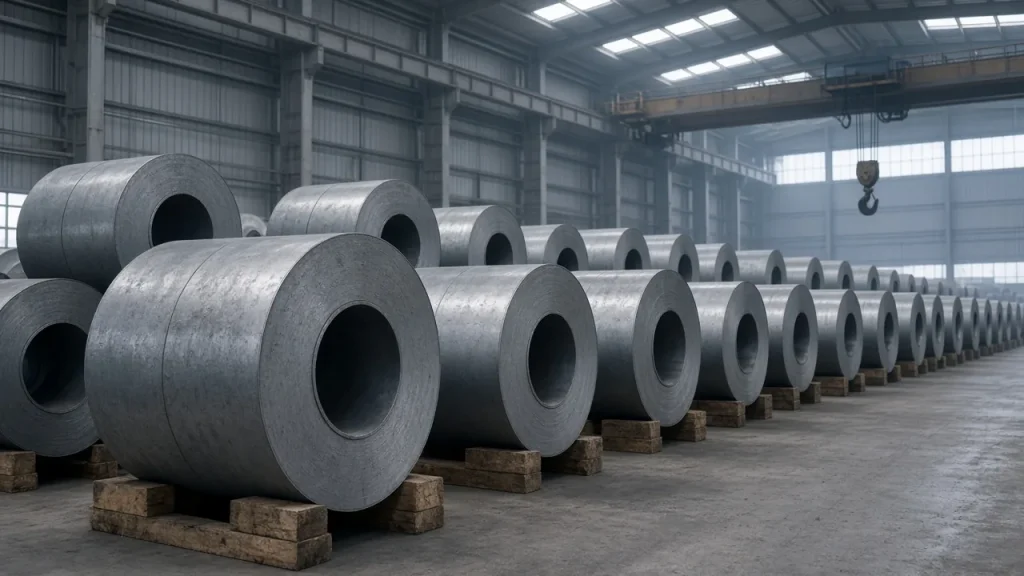
The European Commission plans to keep its anti-dumping duties on hot-rolled stainless steel sheets and coils from China, Indonesia and Taiwan for another five years. Importer Gerber Group, a party to the case, reported that the Commission sent its general disclosure on 21 October (Gerber Group). The final regulation is still pending (SMM). Buyers of stainless hot-rolled coil should plan 2027 supply on the basis that duties of 4.1% to 19.0% stay on top of the EU’s quota limits.
What is in force
The duties were imposed in October 2020 by Implementing Regulation (EU) 2020/1408. Indonesian material pays 17.3%. Most Chinese producers, including the Taigang (TISCO) group, pay 19.0%, with lower rates for Fujian Fuxin (14.6%), Xiangshui Defeng and Fujian Dingxin (17.5%) and Zhenshi Group Eastern Special Steel (9.2%). Taiwan’s Yieh United and Tang Eng pay 4.1%, and Walsin Lihwa and all other Taiwanese producers 7.5%.
Reach steel buyers and importers worldwide
Put your brand in front of the people who buy and trade steel.
Advertise with LoharoThe Commission opened the expiry review on 3 October 2025 at the request of the European steel association EUROFER (notice of initiation). Under the EU’s basic anti-dumping regulation, the duties stay in force while the review runs, and it must end within 15 months of initiation, so by early January 2027. Gerber says it was the only importer to comment.
How the duties meet the quotas
Hot-rolled stainless sheet and strip is also category 8 of the EU tariff quotas. Imports beyond a quota pay 50%, and Regulation (EU) 2026/1384 says this comes in addition to other duties. A 2020 rule that cut the anti-dumping duty when the old safeguard’s above-quota duty applied was tied to that safeguard.
The fourth-quarter TARIC balances after the 27 October allocation show the effect. Indonesia has used about 11 t of its 8,961 t quota (09.9861). Taiwan has used 2,110 t of 4,996 t (09.9860). China has 2,192 t left of 2,379 t, but 3,024 t of requests are waiting for allocation (09.9863). The pool for other countries has 57 t left, with 50 t waiting (09.9610).
Analysis Chinese requests exceed what is left by about 830 t, so not all of them can be met at duty-free terms this quarter. Any excess pays 50% on top of up to 19.0%. With Indonesia’s quota almost unused, the duties appear to keep Indonesian coil out even when duty-free quota room exists. A five-year extension from early 2027 would run to about 2032.
What to watch
- By early January 2027: the Commission’s implementing regulation ending the review, with the final rates.
- Next TARIC allocations: whether China’s line runs out and how much is allocated against the 3,024 t of requests (see our Q4 quota tracker).
Verification status: Verified
- The duty rates, review rules, quota category and 50% duty were read in the regulations and the notice of initiation. The 2020/1408 rates and the review rules were read in the copies of the EU texts published on legislation.gov.uk, because EUR-Lex blocked automated reading. Quota balances and requests were read on the official TARIC pages on 28 October 2026. The proposal to extend the duties comes from the Commission’s general disclosure, which is not public. It is attributed to Gerber Group, an importer in the case, and reported in the same terms by SMM. The 830 t gap is a Loharo calculation. Last fact-check: 28 October 2026.
- Key: Verified = material factual claims are supported by an appropriate primary source or clearly attributed reporting/market assessments; Partially verified = a specific material claim remains unsupported, contradicted or materially overstated; Analysis = interpretation or forecast with sourced premises; Developing = material facts are checked but the situation is still changing.
Ask the Analyst
“1,000 t HRC from China into Rotterdam at €540/t CFR”: landed cost with duty, quota and CBAM in one answer.Ask the AnalystSources
Primary sources
- Notice of initiation of an expiry review of the anti-dumping measures applicable to imports of certain hot rolled stainless steel sheets and coils originating in Indonesia, the People’s Republic of China and Taiwan — Official Journal of the EU, C/2025/5293, 3 October 2025
- Commission Implementing Regulation (EU) 2020/1408 — Official Journal of the EU, 7 October 2020 (read in the legislation.gov.uk copy)
- Regulation (EU) 2016/1036 on protection against dumped imports, Article 11 — Official Journal of the EU (read in the legislation.gov.uk copy)
- Regulation (EU) 2026/1384 addressing the negative trade-related effects of global overcapacity on the Union steel market — Official Journal of the EU, 24 June 2026
- TARIC quota consultation — European Commission (DG TAXUD), order numbers 09.9860–09.9866 and 09.9610, read 28 October 2026
Supporting sources
- EU anti-dumping review of hot-rolled stainless steel — Gerber Group via steelnews.biz, 22 October 2026
- EU set to keep anti-dumping duties on HR stainless from Indonesia, China, Taiwan — Shanghai Metals Market (SMM), 23 October 2026