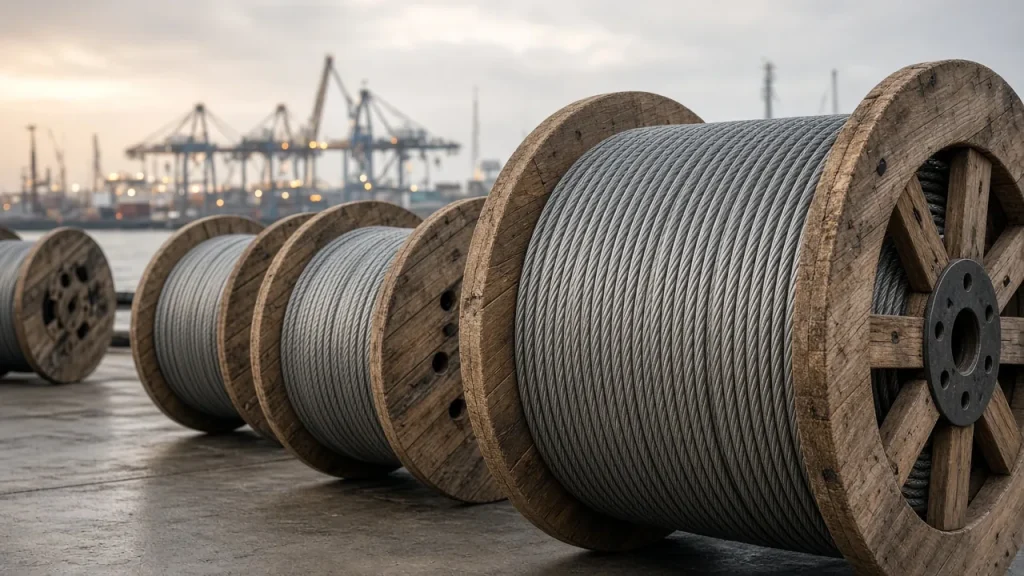
From 31 October, EU customs will register imports of non-stainless steel wire ropes and cables from India, Thailand and Türkiye (Implementing Regulation (EU) 2026/2396). Registration does not charge a duty. It lets the EU backdate anti-dumping duties to registered goods if its investigation finds dumping and the legal conditions are met. These three countries supplied about 55% of the EU’s imports of these ropes by weight in 2025, so buyers ordering for 2027 delivery should settle now who would pay any duty.
What the EU decided
The Commission adopted the regulation on 29 October and published it on 30 October. It applies from the next day, and registration ends after nine months, at the end of July 2027. It covers steel ropes and cables, including locked-coil ropes, with a maximum cross-section over 3 mm, under CN codes ex 7312 10 81 to ex 7312 10 98. Stainless ropes are excluded. The Commission chose to register the imports on its own initiative.
Reach steel buyers and importers worldwide
Put your brand in front of the people who buy and trade steel.
Advertise with LoharoThe investigation began on 24 September 2026 after a complaint from the European Federation of Steel Wire Rope Industries (EWRIS). It covers July 2025 to June 2026 (notice of initiation). The complaint puts dumping margins at 51–134% for India, 23–102% for Thailand and 77–82% for Türkiye. The Commission says these are the complainant’s figures and that it cannot yet estimate any duty.
The same ropes from China have paid a 60.4% anti-dumping duty for years. Since the June 2024 renewal, it also applies to ropes shipped from Morocco and South Korea, except from named Korean and Moroccan producers (Implementing Regulation (EU) 2024/1666).
What it means for buyers
Analysis Backdating has limits. Under the basic anti-dumping regulation (Article 10(4)), a definitive duty can reach registered goods only if they were cleared no more than 90 days before provisional duties apply. Two more conditions must also be met. There must be a history of dumping, or the importer knew or should have known about it. And imports must have risen substantially beyond their level in the investigation period. Provisional duties are due no later than about 24 April 2027 normally, and 24 May 2027 at the latest. On that timetable, the backdating window would open around late January to late February 2027. Provisional duties are allowed from late November, so an earlier decision would move the window forward. These dates are Loharo projections, not Commission dates.
Analysis In Eurostat data for 2025, the EU imported 121,460 t of ropes under these CN codes, worth €268m, from outside the EU. India supplied 25,332 t, Türkiye 23,063 t and Thailand 18,435 t: about 55% of the weight and 40% of the value. China supplied 6,217 t (5%) and South Korea 21,638 t (Eurostat Comext; Loharo calculation). These are “ex” codes, so the totals may include some ropes outside the scope. The investigation period is also not the same as calendar 2025.
Analysis A sharp rise in orders from the three countries before any duty could itself meet the condition for backdating. Buying ahead is therefore no safe hedge for cargoes cleared from late January. One step: for ropes from these countries due after January 2027, agree in the contract who pays any anti-dumping duty, including a backdated one. Make sure the producer’s name is on each invoice, because rates are usually set company by company.
What to watch
- Pre-disclosure: the Commission tells interested parties about planned provisional duties four weeks before they apply, so expect it by late March to late April 2027.
- 24 April 2027 (24 May at the latest): deadline for provisional duties.
- End of July 2027: registration lapses unless it is renewed or replaced by duties. The investigation must end by 24 November 2027.
Verification status: Verified
- The registration, scope, dates, complaint margins and investigation timetable were read in the Official Journal texts (Regulation 2026/2396 and notice C/2026/4914). The rules on backdating and provisional duties come from the basic anti-dumping regulation. The duty on Chinese ropes comes from Regulation 2024/1666. The import figures are from Eurostat Comext, read on 30 October 2026. The import shares and the backdating window are Loharo calculations.
- Key: Verified = material factual claims are supported by an appropriate primary source or clearly attributed reporting/market assessments; Partially verified = a specific material claim remains unsupported, contradicted or materially overstated; Analysis = interpretation or forecast with sourced premises; Developing = material facts are checked but the situation is still changing.
Ask the Analyst
“2,000 t HRC from India into Genoa in Q1 2027 at €610/t CFR”: landed cost with duty, quota and CBAM in one answer.Ask the AnalystSources
Primary sources
- Commission Implementing Regulation (EU) 2026/2396 making imports of certain steel wire ropes and cables originating in India, Thailand and Türkiye subject to registration — Official Journal of the EU, 30 October 2026
- Notice of initiation of an anti-dumping proceeding concerning imports of certain steel wire ropes and cables originating in India, Thailand and Türkiye (C/2026/4914) — Official Journal of the EU, 24 September 2026
- Commission Implementing Regulation (EU) 2024/1666 (steel ropes and cables from China, as extended to Morocco and Korea) — Official Journal of the EU, 7 June 2024
- Regulation (EU) 2016/1036 on protection against dumped imports, Articles 7, 10 and 14 — Official Journal of the EU
- EU trade since 1988 by CN8 (DS-045409), imports of CN 7312 10 81–98, 2025 — Eurostat Comext, read 30 October 2026
Related on Loharo
- EU lowers planned anti-dumping duties on Turkish cold-rolled steel to 3–7.8% before its final ruling
- EU moves to keep anti-dumping duties on hot-rolled stainless from China, Indonesia and Taiwan for five more years
Last fact-check: 30 October 2026.