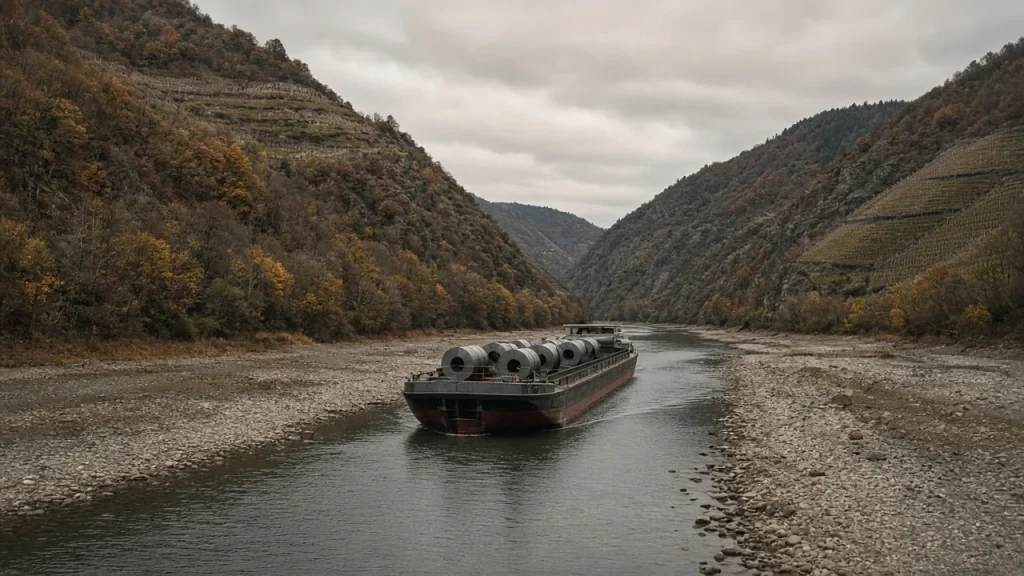
The Rhine at Kaub, the main low-water bottleneck for barges on the Middle Rhine, read 52 cm at 13:00 CET on 29 October, three times the 17 cm it showed a week earlier (WSV, PEGELONLINE). But the federal hydrology institute BfG gives no chance of it reaching the 77 cm low-water mark before 10 November. For buyers taking steel by barge on the Middle and Upper Rhine, part loads and low-water costs are likely to last into mid-November.
What happened
Kaub was below the zero mark at times between 29 September and 8 October, with a low of −6 cm on 1 October. From 9 to 24 October it stayed between 3 and 29 cm, then rose from 25 October. Daily averages have been 54–57 cm since 26 October (WSV, PEGELONLINE).
Reach steel buyers and importers worldwide
Put your brand in front of the people who buy and trade steel.
Advertise with LoharoThat is still below 77 cm, the equivalent low-water level (GlW) used as the low-water reference for navigation at Kaub, and below the 2010–2020 mean low water of 65 cm (WSV gauge data). In its 14-day forecast issued on 28 October, BfG put the chance of the daily average staying below 77 cm at 100% for every day to 10 November (BfG). Downstream, Duisburg-Ruhrort read 214 cm, below its GlW of 227 cm.
Container barge operator Contargo says a 135 m vessel can load only half its capacity at 135 cm at Kaub. At 75 cm, carrying the same tonnage takes four vessels. At 80 cm and below, Contargo’s low-water surcharges are no longer on a published scale and are set by individual agreement (Contargo).
thyssenkrupp Steel said on 9 October that its own barge fleet remained suspended and that it was chartering shallower-draught vessels to keep supplying customers (Kallanish via EUROMETAL).
What it means for buyers
Analysis Price Rhine barge deliveries south of Koblenz as part loads until at least mid-November. Ask the supplier or forwarder whether the quote includes a low-water surcharge, and which gauge reading it is tied to. Even after the water rises, the backlog will not clear at once. Logistics specialists quoted by The Loadstar said vessel schedules can take up to 10 days to return to normal. Securing rail capacity can take up to six weeks’ notice, and replacement trucks up to two weeks (The Loadstar). For tonnes needed before Christmas, book the alternative mode now rather than wait for the river.
Verification status: Verified
- Water levels and reference values come from the federal waterways administration’s (WSV) PEGELONLINE gauge data, read on 29 October; the forecast is BfG’s 14-day forecast of 28 October. Barge loading and surcharge rules come from Contargo’s published low-water terms. The thyssenkrupp statement and the transit and booking times are as reported by Kallanish (via EUROMETAL) and The Loadstar. Last fact-check: 29 October 2026.
- Key: Verified = material factual claims are supported by an appropriate primary source or clearly attributed reporting/market assessments; Partially verified = a specific material claim remains unsupported, contradicted or materially overstated; Analysis = interpretation or forecast with sourced premises; Developing = material facts are checked but the situation is still changing.
Ask the Analyst
“500 t HRC from Turkey into Antwerp in January”: landed cost with duty, quota and CBAM in one answer.Ask the AnalystSources
Primary sources
- Wasserstände Rhein, Pegel Kaub (water levels, Kaub gauge) — WSV, PEGELONLINE (in German), accessed 29 October 2026
- Pegel Kaub: Stammdaten und Hauptwerte (gauge master data and reference values) — WSV, PEGELONLINE (in German), accessed 29 October 2026
- Wahrscheinlichkeitsbasierte 14-Tage-Vorhersage Pegel Kaub (14-day probabilistic forecast, Kaub) — Bundesanstalt für Gewässerkunde (BfG) (in German), 28 October 2026
- Kleinwasserzuschläge (low-water surcharges) — Contargo (in German), accessed 29 October 2026
Supporting sources
- German water levels remain critical in autumn — EUROMETAL / Kallanish, 9 October 2026
- Low Rhine water level driving barge cargo to capacity-strained road and rail — The Loadstar, 15 October 2026
Related on Loharo
Last fact-check: 29 October 2026.