Executive summary
- The blast furnace–basic oxygen furnace (BF-BOF) route made 69.4% of the world’s crude steel in 2025, and electric arc furnaces (EAF) 30.3% (worldsteel).
- Average CO₂ intensity is 2.34 t per tonne for BF-BOF, 0.69 t for scrap-based EAF and 1.47 t for EAF based on direct reduced iron (DRI) (worldsteel).
- Low-carbon flat steel has been sold in Europe at a premium. Fastmarkets assessed it at €100–200/t over HRC in early July 2026 (as reported by EUROMETAL). Spot buyers have been willing to pay much less than project buyers.
- Our view: the premium is worth paying where it secures supply, meets a customer requirement or reduces future CBAM costs. It is hard to justify for commodity grades bought on the spot market.
Key numbers
30.3% Share of global crude steel made in EAFs, 2025 (BOF: 69.4%) Factworldsteel, World Steel in Figures 2026
2.34 t CO₂ per tonne of crude steel, BF-BOF route (scrap-EAF 0.69 t; DRI-EAF 1.47 t) Factworldsteel
€100–200/t Green flat steel premium over HRC, Northern Europe, early July 2026 UncertainFastmarkets via EUROMETAL
≈ €136/t Value of the CO₂ gap between BF-BOF and scrap-EAF at €82.32/t CO₂, before free allocation Calc.Loharo calculation
€1.3bn ArcelorMittal Dunkirk EAF, 2 Mt a year, start-up 2029 FactArcelorMittal
Fact = checked against the cited source · Calc. = Loharo calculation from cited figures or stated assumptions · Uncertain = reported but not confirmed. Unlabelled statements in the text are sourced facts; analysis and uncertainty are labelled inline.
Background
Two ways to make steel
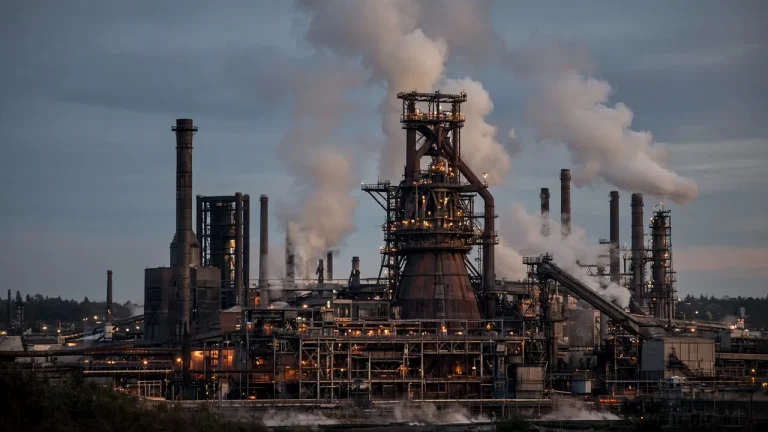
Most of the world’s steel is made in an integrated works. Iron ore and coke go into a blast furnace to make hot metal, which a basic oxygen furnace then turns into steel. worldsteel’s averages for this route, per tonne of crude steel, are roughly 1.37 t of iron ore and 0.78 t of metallurgical coal, plus smaller amounts of limestone (270 kg) and scrap (125 kg).
An electric arc furnace instead melts mainly scrap, direct reduced iron (DRI) or hot metal using electricity. For the scrap-based route, worldsteel’s per-tonne averages are roughly 0.71 t of scrap and 0.59 t of iron ore units, plus some coal (150 kg), limestone (88 kg) and 2.3 GJ of electricity. An EAF can be charged with up to 100% scrap, compared with about 30% for a basic oxygen furnace (worldsteel fact sheet).
Reach steel buyers and importers worldwide
Put your brand in front of the people who buy and trade steel.
Advertise with LoharoIn 2025, the BOF route accounted for 69.4% of global crude steel output and EAFs for 30.3% (World Steel in Figures 2026).
Emissions by route
| Route | CO₂ intensity (t CO₂ per t crude steel) | Typical metallic input |
|---|---|---|
| BF-BOF | 2.34 | Iron ore + coke; scrap about 10% |
| DRI-EAF | 1.47 | Direct reduced iron; scrap below 30% |
| Scrap-EAF | 0.69 | Scrap above 70% |
| Global average | 1.92 | Weighted by production |
DRI-EAF emissions depend heavily on the reducing gas. With natural gas, intensity is well below the blast furnace but above scrap-EAF. Hydrogen-based DRI, as planned at several European projects, could be much lower, but these plants are still being built and financed. Our capacity watch follows Dunkirk, Košice, Stegra and others.
Why it matters commercially
What the green premium pays for
There is no single legal definition of “green steel” in Europe. Fastmarkets, for its assessment, defines it as steel with combined Scope 1, 2 and 3 emissions of no more than 0.8 t CO₂ per tonne. In early July 2026 it assessed the premium for such flat steel at €100–200/t over its Northern European HRC index (EUROMETAL). Market sources quoted by EUROMETAL in April said project and end-user contracts achieved around €160–200/t. Spot buyers were willing to pay only €60–100/t. More recent reports point the same way. At an industry event in Düsseldorf on 6 October, premiums achieved in trial purchases were put at around €150–160/t, with spot deals for bigger lots settled at around €100/t (EUROMETAL, 14 October 2026). These are assessments and market reports that we cannot check independently. Uncertain
On the cost side, producers are making large investments. ArcelorMittal plans a €1.3bn, 2 Mt EAF at Dunkirk, due to start in 2029. Nippon Steel plans a €0.9bn, 1.6 Mt EAF at Košice from 2030. Stegra has said it needs additional capital for its hydrogen-based project in Sweden.
How CBAM changes the comparison
At the Q3 2026 CBAM certificate price of €82.32, the 1.65 t CO₂ gap between the average blast furnace and scrap-EAF routes is worth about €136 per tonne of steel. Calc. That is a gross figure. Importers currently pay only on emissions above a free-allocation deduction, so the actual CBAM difference for imported steel is smaller. But the gap is of the same order as the green premium, and it will widen as free allocation phases out. Our CBAM explainer has more detail.
Our view: when the premium makes sense
Pay it where low-carbon steel is a requirement: an automotive or public-procurement contract that sets an emissions limit, or a customer that reports Scope 3 emissions and will pay for the reduction. Long-term offtakes also secure supply from new capacity.
Question it for commodity grades bought on the spot market, where the end customer will not pay more. Here, the main benefit is a lower future CBAM or carbon cost, so compare the premium with that.
Always ask for the emissions figure per tonne, how it was calculated, and whether it has been independently verified. “Green” without a number is not a specification.
Who is affected
Automotive and appliance buyersPremium Most likely to have emissions targets and to accept a premium; secure verified data and long-term volume.
Construction and long-product buyersLower exposure Much rebar and sections are already EAF-made from scrap, so their emissions are already relatively low.
Importers of blast-furnace flat steelCarbon cost The largest CBAM exposure as free allocation declines.
Scrap-dependent producersInput risk EAF growth increases demand for good-quality scrap and DRI, which may raise their prices.
Stay ahead of the steel market
What to watch next
- EAF start-ups: Dunkirk (2029) and Košice (2030), plus progress on the financing of hydrogen-based DRI projects.
- A common definition of low-carbon steel in EU policy, which would make premiums comparable.
- CBAM benchmark revisions from 1 January 2027 and the pace at which free allocation is phased out.
- Scrap availability: EU rules on scrap exports to non-OECD countries, covered in our raw materials update.
Verification status: Partially verified
- Production shares, emissions intensities and input ratios were checked against worldsteel; investment figures against ArcelorMittal, Nippon Steel and Stegra releases; the CBAM price against the European Commission. Green steel premiums are Fastmarkets and McCloskey assessments as reported by EUROMETAL and cannot be independently checked. The €136/t figure is a labelled Loharo calculation.
- Key: Verified = every factual claim checked against a primary source; Partially verified = core facts confirmed, some figures from secondary/market sources; Analysis = interpretation; Developing = story still moving.
Ask the Analyst
“500 t HRC from Turkey into Antwerp in January”: landed cost with duty, quota and CBAM in one answer.Ask the AnalystSources
Primary sources
- World Steel in Figures 2026 — World Steel Association, 2026
- Sustainability Indicators Report 2025 — World Steel Association, 2025
- Raw materials — World Steel Association, accessed 11 October 2026
- Fact sheet: Steel and raw materials — World Steel Association, 2023
- Press release on the Dunkirk electric arc furnace — ArcelorMittal Europe, 2026
- Press release on the U. S. Steel Košice EAF investment — Nippon Steel, 16 September 2026
- Stegra implements changes following 100-day review under new owners — Stegra (Cision), 2026
- Price of CBAM certificates — European Commission, Q3 price published 5 October 2026
Supporting sources
- European green flat steel spot trading thin, though some sellers secure premiums — EUROMETAL (Fastmarkets), July 2026
- EU green steel spot-contract premium gap persists — EUROMETAL (McCloskey), April 2026
Information as of 15 October 2026 (re-checked). This is an evergreen explainer: figures are dated and linked to their sources, and calculations state their assumptions. Prices quoted from third-party assessments are attributed to the publisher that reported them; Loharo does not publish its own price assessments. This article is market intelligence, not investment, legal or tax advice.