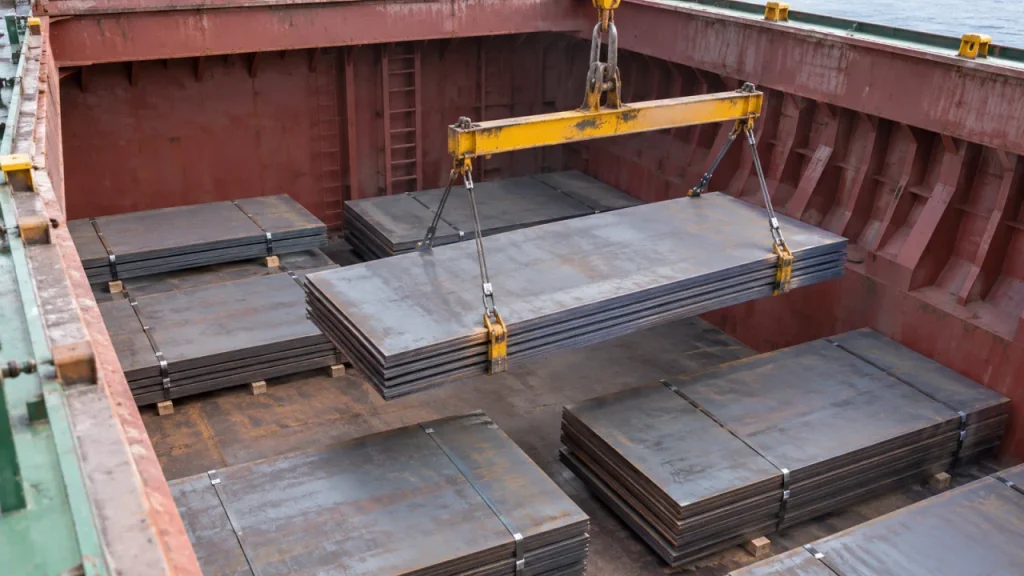
A transparent comparison framework: the HRC rows are live calculator outputs; CN 7207 semi-finished results are shown as a range because defaults and benchmarks differ by 8-digit code.
Buying slab for downstream rolling and buying finished hot-rolled coil solve different supply-chain problems. CBAM can affect both product pathways, but the buyer cannot compare their obligations by treating a finished-coil default as a slab value. The free Loharo calculator returns HRC results under CN 7208 and, separately, a range of results under CN 7207 (the tool’s product label is “Semi-finished non-alloy steel (billets, slabs)”). Defaults and benchmarks differ by 8-digit code, so this note shows that live range rather than a single invented “slab” figure. Conversion, yield and logistics costs still have to come from the buyer’s own quotes.
Reach steel buyers and importers worldwide
Put your brand in front of the people who buy and trade steel.
Advertise with LoharoExecutive summary
- For HRC CN 7208 from India, Türkiye and Viet Nam, the live calculator shows 2026 estimates using 1,000 tonnes and the Q3 certificate-price reference.
- Under CN 7207 the calculator returns a range, not a single slab figure: India €260.46–€277.17/t, Türkiye €99.69–€148.75/t and Viet Nam €80.26–€103.31/t (1,000 t, import year 2026; 18 eight-digit codes). The exact code must still be confirmed for a shipment.
- Compare total chain cost, not only CBAM per tonne: slab may require rolling, yield, energy, handling and lead-time inputs that are not included here.
Loharo calculation: coil reference, slab inputs held open
| Route | Product / calculator input | Displayed 2026 estimate | Status |
|---|---|---|---|
| Finished coil | HRC CN 7208, India, 1,000 t | €277.58/t; €277,583 total | Live calculator result |
| Finished coil | HRC CN 7208, Türkiye, 1,000 t | €109.90/t; €109,897 total | Live calculator result |
| Finished coil | HRC CN 7208, Viet Nam, 1,000 t | €102.82/t; €102,818 total | Live calculator result |
| Semi-finished (billets, slabs) | CN 7207, India, 1,000 t — 8-digit codes vary | €260.46–€277.17/t | Live calculator range (18 codes) |
| Semi-finished (billets, slabs) | CN 7207, Türkiye, 1,000 t — 8-digit codes vary | €99.69–€148.75/t | Live calculator range (18 codes) |
| Semi-finished (billets, slabs) | CN 7207, Viet Nam, 1,000 t — 8-digit codes vary | €80.26–€103.31/t | Live calculator range (18 codes) |
Example of why the range exists (India, 1,000 t, 2026): CN 7207 11 11 returns €277.17/t (default 4.27 tCO₂e/t; benchmark 1.364); CN 7207 11 90 returns €260.46/t (default 4.32 tCO₂e/t; benchmark 1.629). The heading includes billets as well as slabs, so the buyer must confirm both the 8-digit code and the actual product before comparing it with coil.
Inputs for the three coil rows: product HRC CN 7208; origin as stated; 1,000 tonnes; import year 2026. The calculator output is the displayed total after its default-value, phase adjustment and whole-certificate rounding. It is not recalculated from rounded intermediate emissions. The coil rows cannot be copied across to a slab offer. Use the CN 7207 range only as a screen, then run the exact 8-digit code in the calculator and confirm that the goods are slabs rather than other semi-finished products in the same heading.
Why slab-versus-coil comparisons often mislead
A slab offer may have a lower nominal product price but requires further transformation before it meets the buyer’s specification. A coil offer may be ready for service-centre or factory use, but its price includes a different stage of processing and may have a different delivery basis. The buyer should therefore align dimensions, grade, tolerances, yield loss, rolling capacity, conversion charges, energy, handling, finance and delivery dates. Those commercial values are [CHECK] unless supported by current quotations or internal data.
CBAM also follows product classification and applicable emissions rules. The buyer should not assume that a tonne of slab and a tonne of HRC receive identical default values or free-allocation treatment. Nor should the buyer compare a verified slab emissions file with an HRC origin default without confirming the product and system boundary. Keep the CBAM line as a separate, dated assumption until the classification and data method are verified.
Buyer comparison framework
- Confirm the exact CN code and scope for slab and coil; mark any classification ambiguity [CHECK].
- Run each supported product/origin/year in the free calculator and preserve the displayed data version. If slab is unsupported, do not improvise a value.
- Request verified supplier data that matches the installation, product, period and emissions boundary; ask whether it is usable under the current CBAM method.
- Compare the downstream conversion route, expected yield, quality risk, logistics and delivery lead time using documented quotes.
- Run low/base/high scenarios only for sourced or buyer-supplied inputs. Leave missing conversion, freight and supplier values as [CHECK].
For a buyer with an integrated rolling option, slab can offer flexibility if capacity and delivery are secure. For a service centre buying coil, ready-to-process product may reduce operational steps, but the price and availability must be compared on the same basis. A trader should show the product code and CBAM method on each offer so that the buyer does not confuse a commodity label with the customs classification.
What would change this view: the exact 8-digit slab code and a single calculator result for that code, verified supplier-specific emissions for the same product and boundary, plus current conversion and logistics quotes. Buyer action: send both product classifications and the intended import year to the customs and CBAM teams before treating any comparison as a landed-cost decision.
Ask the Analyst
“What could CBAM add to Indian HRC delivered to Rotterdam in 2027?”: landed cost with duty, quota and CBAM in one answer.Ask the AnalystSources
- Loharo free CBAM calculator — checked 23 Nov 2026.
- European Commission CBAM legislation and guidance — official default values and guidance.
- Implementing Regulation (EU) 2025/2621 — default values, corrected by Implementing Regulation (EU) 2026/1740.
- Implementing Regulation (EU) 2025/2620 — benchmarks.
- Price of CBAM certificates — European Commission.
Verification status: Partially verified
HRC and CN 7207 range outputs were copied from Loharo’s live calculator on 10 November 2026. The exact 8-digit slab code, supplier emissions, and conversion or logistics costs remain to be confirmed for a real offer; they are not invented here.
Last fact-check: 23 November 2026. Estimate only; not legal advice or an official CBAM declaration.
What could CBAM add to your imports? Try the free calculator, check the Steel Trade Measures Tracker, or request supplier-specific CBAM Cost Check from €490.