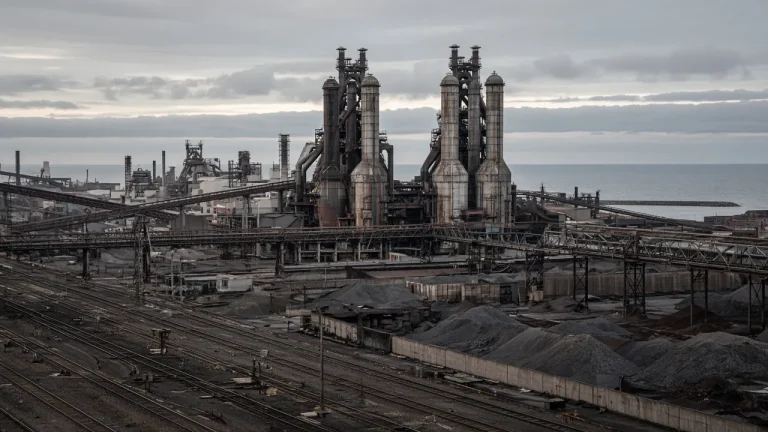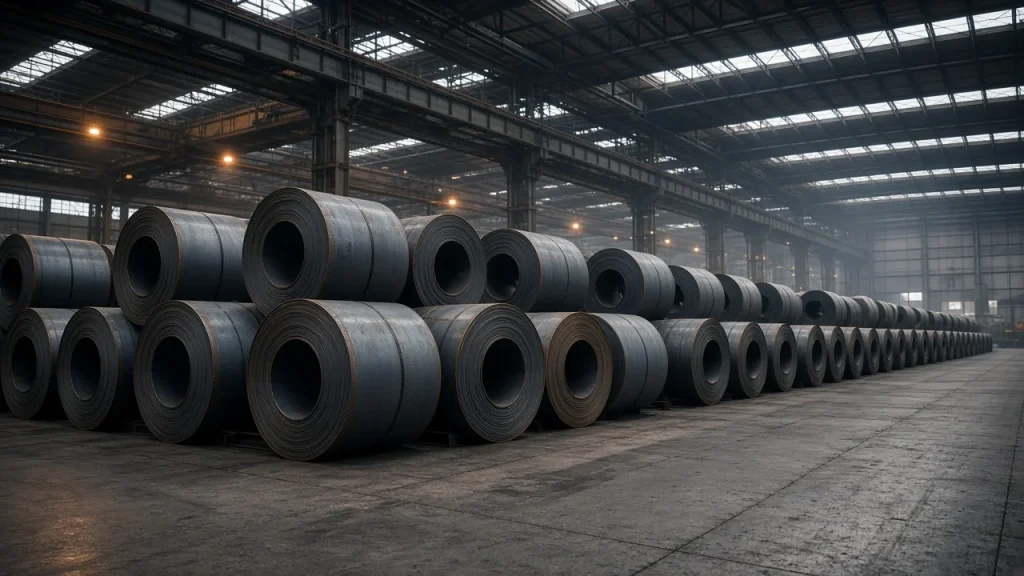
China made about 100 million tonnes (Mt) more crude steel than it used at home in January–September 2026, and its mills now hold their largest steel stocks in four years. That is a Loharo calculation from figures the China Iron and Steel Association (CISA) gave on 30 October. For EU buyers the direct effect is limited, because Chinese hot-rolled coil has almost no EU tariff quota and pays a 50% duty above it. The pressure shows up in Asian export markets and in prices instead. No step is needed yet. What matters is whether CISA’s call for output cuts holds into 2027.
What CISA reported
In its third-quarter press release (CISA, in Chinese), the association said crude steel output fell 2.9% to 725 Mt in the first nine months. Apparent consumption, in crude-steel terms, fell faster: down 3.8% to 625 Mt. Finished-steel exports fell 2.6% to 85.64 Mt, while the average export price rose 1.8% to $709 a tonne. CISA links this mix of lower volume and higher price to the export licence system China introduced in January.
Reach steel buyers and importers worldwide
Put your brand in front of the people who buy and trade steel.
Advertise with LoharoStocks are high. The average finished-steel inventory at the mills in CISA’s statistical survey was 16.85 Mt over the nine months, the highest in four years. In early October it reached 16.97 Mt, 20% above the start of the year. Stocks held by traders and warehouses were 9.39 Mt, up 30.2% since the start of the year. Profits at the surveyed mills fell 27.4% to 71.8 billion yuan, and 29.6% of them were making a loss. CISA blames weak demand and fuel costs: in September coking coal cost the mills 51.2% more than a year earlier. It asked mills to set output by sales and orders, and said it would warn about ten mills that had not kept to that rule.
China’s home market did not pick up in October. The official construction activity index fell 2.3 points to 48.0, and the manufacturing PMI fell to 49.3, according to the National Bureau of Statistics (in Chinese). CISA’s Su Changyong told China Business Journal that he expects total exports to fall moderately, citing a record 2025 base and more trade remedy cases abroad (reported via Sina Finance, in Chinese).
Loharo calculation: the gap between output and home use
| Jan–Sep 2026 | Jan–Sep 2025 (implied) | Change | |
|---|---|---|---|
| Crude steel output | 724.8 Mt | 746.4 Mt | −21.6 Mt |
| Apparent consumption (crude-steel terms) | 625 Mt | 649.7 Mt | −24.7 Mt |
| Gap: output not used at home | 99.8 Mt (13.8% of output) | 96.7 Mt (13.0%) | +3.1 Mt |
| Net finished-steel exports (exports − imports) | 81.6 Mt | 83.4 Mt | −1.8 Mt |
Analysis Output fell by about 22 Mt, but home use fell by about 25 Mt, so the volume China has to sell abroad or store rose by about 3 Mt. CISA rounds its figures, so the change could be anywhere from about 1 Mt to 5 Mt. Net finished-steel exports actually fell by 1.8 Mt, so the wider gap is not explained by finished exports. The two measures are not like-for-like. The gap is in crude-steel terms and also covers semi-finished steel such as billet, while the customs figure counts finished products only. CISA does not explain the difference, so it is not clear whether more billet exports, rising stocks or its conversion method account for it.
What it means for EU buyers
Analysis Very little of this steel can come straight into the EU. The pool of hot-rolled coil quota that China shares with other origins without their own allocation is about 22,256 t a year, and imports above quota pay 50% (our guide to the EU quota regime). The risk is indirect. China’s domestic price index averaged 1.48% lower than a year earlier, while CISA’s international index averaged 12.2% higher. Both are nine-month averages, so the year-on-year gap between them is 13.7 points (Loharo calculation; the two indices have different bases, so only their changes can be compared). As long as that gap persists, Chinese mills have a reason to keep exporting, and Asian mills that also sell to Europe face Chinese competition at home and in export markets. That is an inference, not something the data shows directly.
Analysis For your contracts: in import contracts for first-quarter 2027 delivery, state who pays the 50% over-quota duty if the origin’s quota is used up before customs clearance. Also ask for a mill test certificate that shows the melt-and-pour country and heat number, because customs can reject imports without them.
Stay ahead of the steel market
What to watch
- Around 7 November: China’s October customs figures show whether exports stay above 10 Mt a month.
- Mid-November: NBS October output, to see whether mills are cutting production as CISA asked.
- 1 January 2027: EU quotas for the first quarter of 2027 open.
Verification status: Verified
- All China figures come from CISA’s 30 October press release, read in Chinese in full, and match Yicai’s independent report of the briefing. The PMI figures come from the National Bureau of Statistics, and the export outlook is attributed to CISA’s Su Changyong as reported by China Business Journal. The gap, the implied 2025 figures and the index comparison are Loharo calculations.
- Key: Verified = material factual claims are supported by an appropriate primary source or clearly attributed reporting/market assessments; Partially verified = a specific material claim remains unsupported, contradicted or materially overstated; Analysis = interpretation or forecast with sourced premises; Developing = material facts are checked but the situation is still changing.
Ask the Analyst
“1,000 t HRC from Japan into Houston”: landed cost with duty, quota and CBAM in one answer.Ask the AnalystSources
Primary sources
- 钢协2026年三季度信息发布会提出:砥砺前行 攻坚克难 推动钢铁行业向新、向智、向绿、向好 (CISA third-quarter 2026 press release, full text, in Chinese) — China Iron and Steel Association, 30 October 2026 (posted on the CISA website 2 November 2026)
- 10月份采购经理指数有所回落 (October 2026 PMI, NBS interpretation, in Chinese) — National Bureau of Statistics of China, 31 October 2026
Supporting sources
- 中国钢铁工业协会信息发布会新闻稿 (CISA press release, full-text republication, in Chinese) — Mysteel, 30 October 2026
- 燃料成本上升挤压钢企利润,钢材库存处近四年高位 (fuel costs squeeze steel profits; stocks at four-year high, in Chinese) — Yicai, 31 October 2026
- 钢材库存达到4年高位 中钢协呼吁以需定产 (steel stocks at four-year high; CISA urges output to match demand, in Chinese) — China Business Journal via Sina Finance, 1 November 2026
Related on Loharo
- China’s September crude steel output holds flat at 73.59 Mt as property investment falls 20.6%: export pressure on Europe stays
- China’s September steel exports: 10.49 Mt, below the ship-tracking estimate
- EU steel tariff quotas three months in: 50% duty, melt-and-pour proof and a looming Q1 2027 crunch
Last fact-check: 2 November 2026.