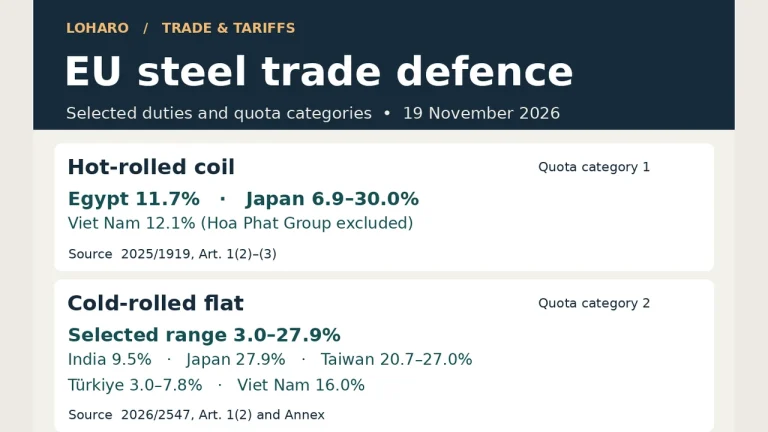
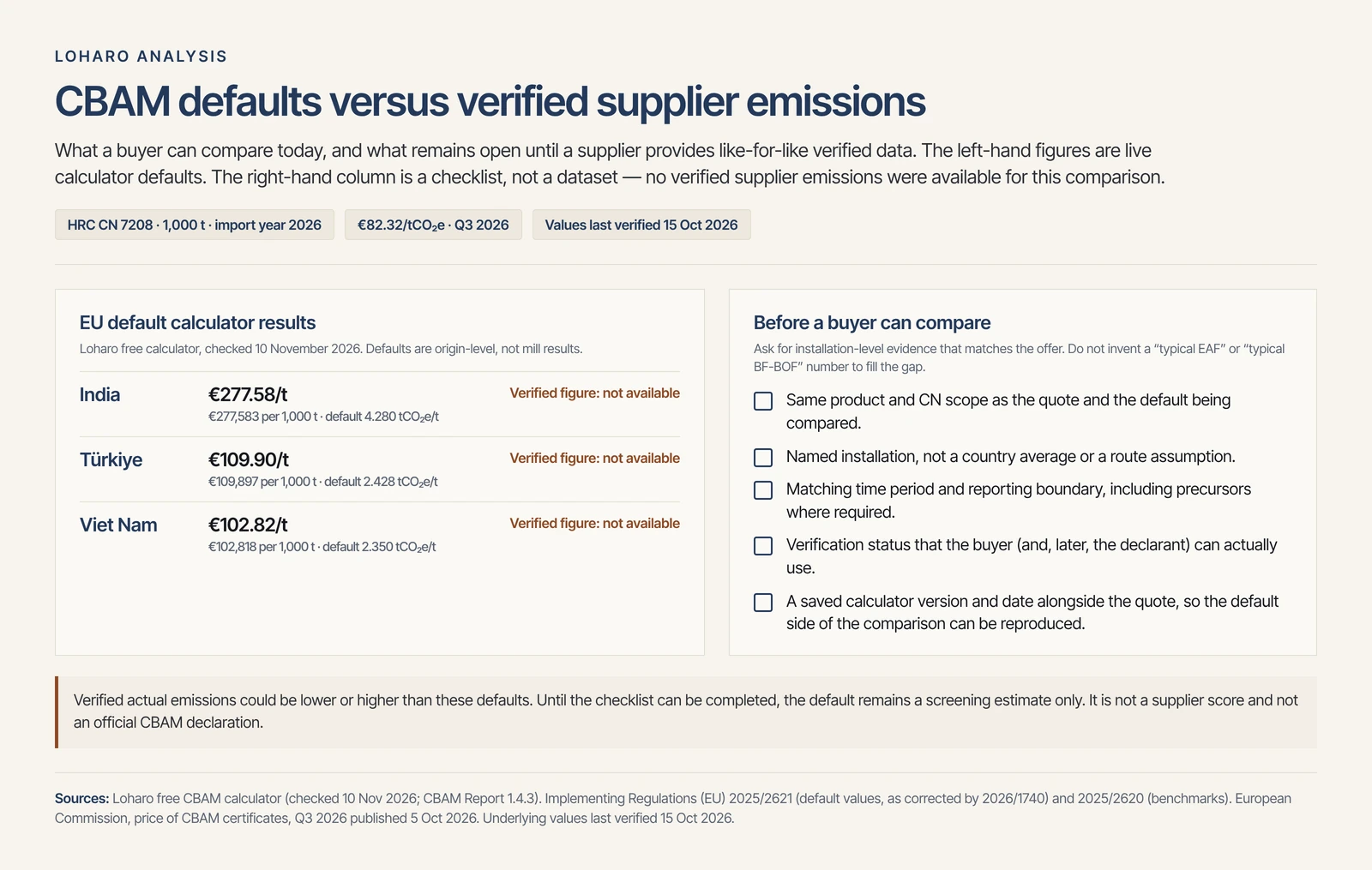
The free Loharo calculator shows a wide spread between EU default-value estimates for HRC imports from India, Türkiye and Viet Nam. The figures are screening estimates using a Q3 2026 certificate-price reference, not a comparison with verified supplier emissions. Buyers should compare supplier data only after confirming that it covers the same product, installation and period.
Executive summary
- For 1,000 tonnes of HRC CN 7208 imported in 2026, the calculator returned €277,583 for India, €109,897 for Türkiye and €102,818 for Viet Nam.
- These are default-value estimates, not verified supplier assessments, and use the Commission’s Q3 2026 price of €82.32/tCO₂e, published 5 October.
- Ask suppliers for verified installation-level data before comparing it with defaults; use a consistent product boundary and import year.
What the calculator comparison says
For an EU buyer, a CBAM estimate can change the apparent economics of an import lane, but an origin-level default is not a supplier score. Loharo’s free calculator was run on 10 November 2026 for HRC CN 7208, 1,000 tonnes and import year 2026. The results below are the tool’s displayed default-value scenario estimates, not an official CBAM declaration.
Reach steel buyers and importers worldwide
Put your brand in front of the people who buy and trade steel.
Advertise with LoharoLoharo calculation: same shipment size and price reference
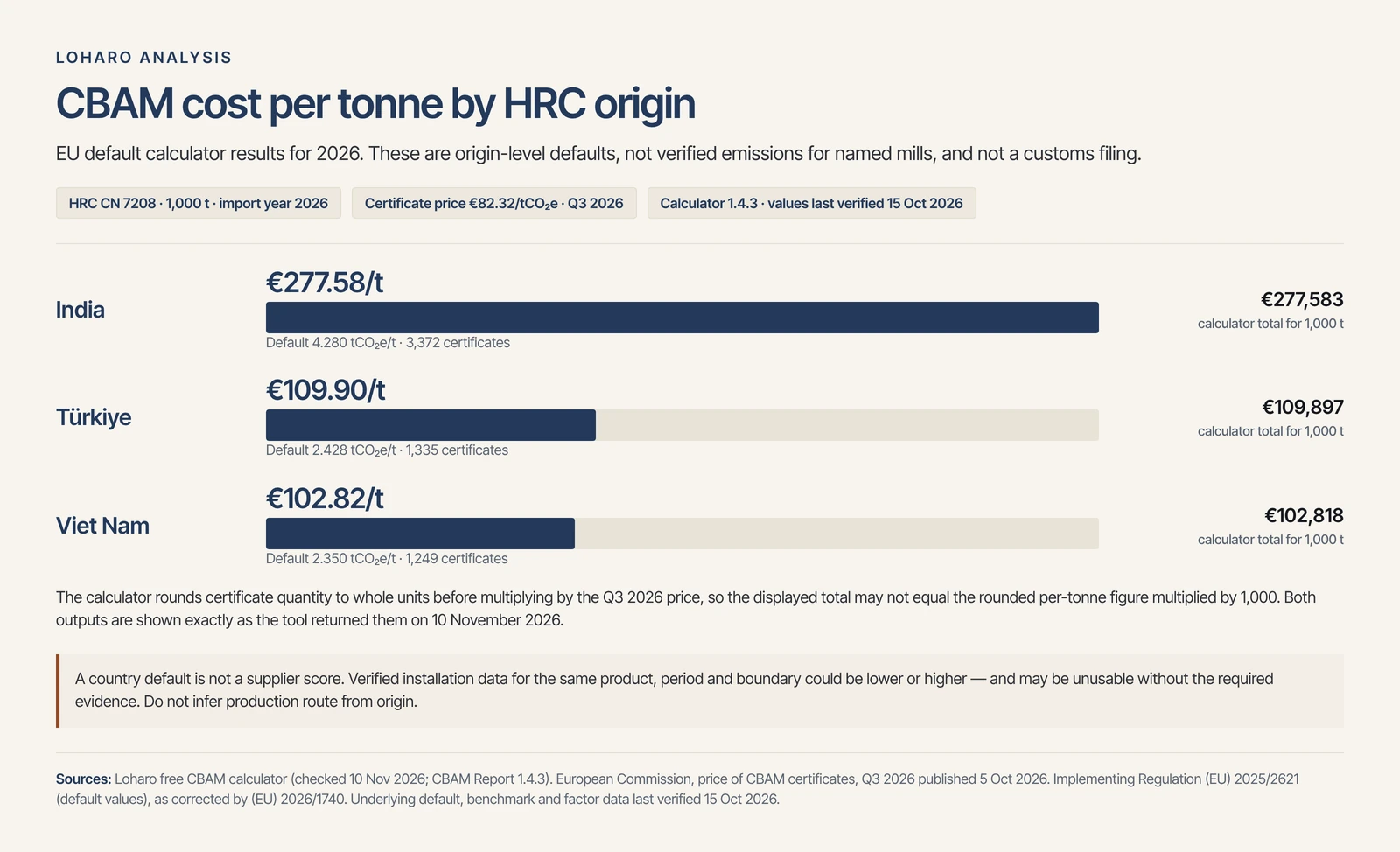
Analysis. Loharo calculation. The calculator applies the origin-specific EU default emissions value, adds the 2026 10% markup, subtracts the 2026 free-allocation adjustment using the 1.370 tCO₂e/t BF/BOF benchmark, 97.5% CBAM factor and 100% CSCF, then multiplies by the reference certificate price of €82.32/tCO₂e. The interface rounds the certificate quantity to a whole number before multiplying by price. The results above are the calculator’s displayed totals, not a fresh estimate from rounded intermediate emissions.
Defaults versus verified supplier data
An EU default is a common fallback value defined for the applicable product and origin pathway. Verified actual emissions are installation-specific data that a producer must substantiate and have verified under the CBAM rules. A buyer should not assume the actual figure will be lower: it could be lower or higher, and it may not be usable if the supplier cannot provide the required verification or if the product and production route do not match the record.
The comparison also has a time boundary. The calculator’s default-value file references Implementing Regulation (EU) 2025/2621 as corrected by (EU) 2026/1740. That file, the benchmark file and the CBAM factor were last verified in Loharo’s CBAM values on 15 October 2026. The Commission’s Q3 certificate price, published on 5 October, is the latest displayed 2026 quarterly price. Recheck all inputs when the Commission updates the data or when the import quarter changes.
Buyer decision framework
The checklist in the graphic is the evidence a buyer needs before treating a supplier claim as comparable with these defaults. Use the calculator for a first screen and save the displayed data version. Before committing, compare a complete verified-data pack with the default estimate and the purchase terms, and record which input would change the commercial decision.
What it means for buyers
The observed spread is a reason to request reliable supplier information, not to rank countries or mills. Importers should distinguish “origin default” from “supplier verified” in internal models and should avoid using a default-based calculator result as a customs filing. Where several lines or suppliers are involved, a sourced, supplier-specific Cost Check is more appropriate than comparing isolated default estimates.
What to watch next
Recheck the Commission’s CBAM default-value and benchmark publications, and the next certificate-price publication. Buyer action: ask each shortlisted supplier now whether verified installation data is available for the exact HRC product and 2026 production period; do not infer that it exists.
Verification status: Partially verified
The three displayed estimates and their inputs were checked in Loharo’s live calculator on 10 November 2026. Its underlying default, benchmark and factor data were last verified on 15 October 2026; no verified supplier dataset was available for a like-for-like comparison.
Ask the Analyst
“What could CBAM add to Indian HRC delivered to Rotterdam in 2027?”: landed cost with duty, quota and CBAM in one answer.Ask the AnalystSources
Primary sources
- Price of CBAM certificates — European Commission, Q3 2026 price published 5 October 2026.
- CBAM legislation and guidance: default values and benchmarks — European Commission, accessed 10 November 2026; files shown with 6 August and 10 August 2026 dates.
- Commission Implementing Regulation (EU) 2025/2621 — EUR-Lex; default values, as corrected by (EU) 2026/1740.
- Commission Implementing Regulation (EU) 2025/2620 — EUR-Lex; default CBAM benchmarks.
- Free EU CBAM calculator — Loharo, results checked 23 November 2026; default-value, benchmark and factor data last verified 15 October 2026.
Last fact-check: 23 November 2026. Information and estimates only; not legal advice or an official CBAM declaration.
What could CBAM add to your imports? Try the free calculator, check dated balances in the Steel Trade Measures Tracker, or request a supplier-specific CBAM Cost Check from €490.