The EU has set out how a carbon price already paid in the exporting country will cut a steel importer’s CBAM bill, and its list of qualifying schemes covers most of Europe’s big Asian suppliers: China, India, Japan, South Korea, Taiwan and Indonesia. Commission Implementing Regulation (EU) 2026/2498 was published on 16 November and applies back to 1 January 2026 (Official Journal). The catch for buyers is that free allowances and other rebates come off the price first, so the deduction depends on what a mill actually paid, not on the headline carbon price.
What the rules say
A carbon price can come from an emissions trading system, a carbon tax, a levy or a fee. It counts only if the scheme is binding on all operators in the sector and charges the same for goods sold at home and goods exported, the Commission said (DG TAXUD, 16 November). The regulation was adopted on 5 November, enters into force on the third day after publication and must be revised by 2027 at the latest.
Reach steel buyers and importers worldwide
Put your brand in front of the people who buy and trade steel.
Advertise with LoharoAnything that lowers what the mill really pays is subtracted before the deduction is worked out: emissions covered by free allowances, emissions below an intensity baseline in a baseline-and-credit scheme, exempt emissions, reduced rates and refunds (Article 9). International carbon credits count only if issued under Article 6 of the Paris Agreement, and for no more than 10% of the emissions covered.
There are two ways to claim. The producer can prepare an operator’s carbon price report with evidence, certified by an independent person; for 2026 and 2027 an accredited CBAM verifier can do this without extra accreditation, and from 2028 a specific EU accreditation is needed. Or the declarant can use a default carbon price for the country, which the Commission will publish in the CBAM Registry in time for the first CBAM declarations, due by 30 September 2027.
Loharo table: which Asian and nearby origins are on the list
| Origin | Scheme named in Annex II | Type | Main rebate the EU expects to subtract |
|---|---|---|---|
| China | National Emissions Trading System | Emissions trading | Free allowances; liability cap |
| India | Carbon Credit Trading Scheme | Baseline-and-credit | Emissions under the baseline |
| Japan | GX-ETS; carbon tax (Tax for Climate Change Mitigation) | Emissions trading; fuel-based tax | Free allowances (GX-ETS) |
| South Korea | K-ETS | Emissions trading | Free allowances |
| Taiwan | Carbon fee | Fuel-based fee | Reduced rate; exempted emissions |
| Indonesia | Economic Value of Carbon Trading Scheme | Emissions trading | Free allowances |
| Türkiye | Emission Trading System | Emissions trading | Free allowances |
| Viet Nam | Not listed | — | Absence does not mean a scheme is ineligible; the list is to be updated |
Loharo calculation: what a deduction is worth on a tonne of coil
The regulation turns the price paid into fewer certificates with a simple formula: carbon price paid per tonne of CO₂e × the coil’s embedded emissions ÷ the yearly CBAM reference price. In euros, the saving per tonne of steel is therefore the carbon price effectively paid × the embedded emissions. We applied that to one tonne of blast-furnace hot-rolled coil (CN 7208) imported in 2026, with the same method as our Indian coil landed-cost check.
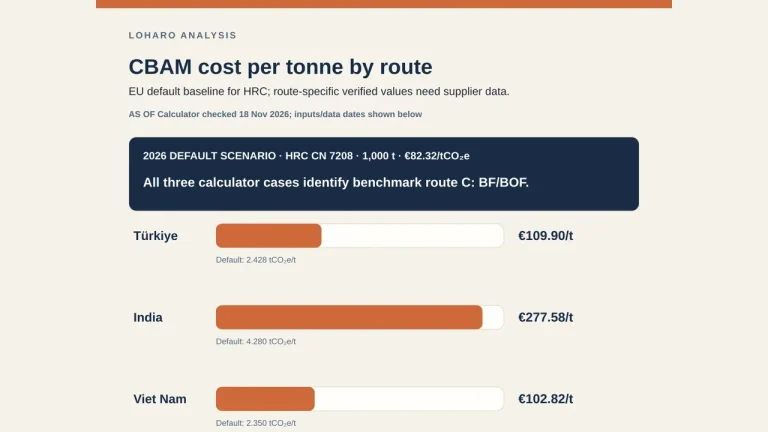
Inputs: actual embedded emissions of 2.0 t CO₂e per tonne (an illustrative blast-furnace figure, not a default value); free-allocation benchmark 1.370 × the 2026 CBAM factor of 97.5% = 1.336 t; CBAM price €82.32 (the third-quarter 2026 price). Gross CBAM cost: (2.0 − 1.336) × €82.32 = about €54.70 a tonne.
| Carbon price the mill effectively paid, after free allowances (€ per t CO₂e) | Deduction per tonne of coil (× 2.0 t) | CBAM cost after deduction | Cut in the CBAM bill |
|---|---|---|---|
| €0 | €0 | €54.70 | 0% |
| €1 | €2 | €52.70 | 4% |
| €5 | €10 | €44.70 | 18% |
| €10 | €20 | €34.70 | 37% |
| €20 | €40 | €14.70 | 73% |
Analysis The effective price is roughly the headline price × the share of emissions the mill actually pays for. A mill paying a €10 headline price but receiving free allowances for 90% of its emissions has an effective price of about €1, worth some €2 a tonne of coil in the table above, not €20. Most of the Asian schemes on the list hand out free allowances or use intensity baselines, so for now Loharo expects deductions on Asian coil to be small, though no default carbon prices have been published yet.
The yearly reference price is the average of the year’s CBAM prices. For 2026, the first three quarters were €75.36, €75.28 and €82.32 (Commission), an average of €77.65; the fourth-quarter price is due on 4 January 2027. This changes how many certificates a deduction is worth, not its euro value.
What this means for buyers
Do not accept a supplier’s headline carbon price as a discount on CBAM. Ask whether the mill pays for emissions above its free allocation or baseline, and whether it will provide an operator’s carbon price report certified by an accredited verifier for 2026 shipments. Agree in the contract who benefits if a deduction is claimed. Until the Commission publishes default carbon prices, price Asian coil on the full CBAM cost; our CBAM 2026–2030 buyer guide has the wider timetable.
Stay ahead of the steel market
What to watch
- Default carbon prices: the Commission will publish the method and the country values in the CBAM Registry before the first declarations.
- Guidance and templates: due “in the coming months” for producers, verifiers and declarants.
- 4 January 2027: the fourth-quarter 2026 CBAM price, which completes the 2026 reference price.
- 30 September 2027: first CBAM declarations for 2026 imports, where deductions can first be claimed.
- Earlier coverage: our third-quarter CBAM price report worked out what 2026 imports will owe at €82.32; that price is unchanged, and the new rules only add a possible deduction for carbon prices paid at origin.
Verification status: Verified
- The rules, eligibility conditions, rebates, credit limit, verification arrangements, default prices and formula come from Implementing Regulation (EU) 2026/2498 in the Official Journal and the Commission’s statement of 16 November; the list of schemes from Annex II; CBAM prices from the Commission’s price page; the benchmark from Implementing Regulation (EU) 2025/2620. The per-tonne deduction table and the headline-to-effective example are Loharo calculations on stated, illustrative inputs.
- Key: Verified = material factual claims are supported by an appropriate primary source or clearly attributed reporting/market assessments; Partially verified = a specific material claim remains unsupported, contradicted or materially overstated; Analysis = interpretation or forecast with sourced premises; Developing = material facts are checked but the situation is still changing.
Sources
Primary sources
- Commission Implementing Regulation (EU) 2026/2498 of 5 November 2026 (conversion of the carbon price paid in a third country into a reduction of CBAM certificates), Official Journal, 16 November 2026
- CBAM: Commission adopts rules on the recognition of carbon prices paid in non-EU countries, DG Taxation and Customs Union, 16 November 2026
- Price of CBAM certificates, DG Taxation and Customs Union
- Commission Implementing Regulation (EU) 2025/2620 (CBAM benchmarks), Official Journal
Supporting sources
- EU sets rules for deducting carbon prices paid in third countries under CBAM, SteelRadar via EUROMETAL, 17 November 2026
Last fact-check: 18 November 2026.
Planning steel imports into the EU? Estimate CBAM costs with the free calculator using EU default values. For supplier-specific emissions and a portfolio review, see the CBAM Cost Check.