Executive summary
- On average, the blast furnace route uses about 1,370 kg of iron ore and 780 kg of metallurgical coal per tonne of crude steel. The scrap-based EAF route uses about 710 kg of scrap and 2.3 GJ of electricity (worldsteel).
- On those ratios, a $10/t move in iron ore changes blast-furnace input costs by about $13.70/t of steel, a $10/t move in coking coal by about $7.80/t, and a $10/t move in scrap changes EAF costs by about $7.10/t. These are simplified Loharo calculations.
- Raw material swings can be large. In the World Bank’s monthly series, iron ore peaked at $214.43/t in June 2021 and fell to $93.34/t by November 2022.
- Finished steel prices follow raw materials only partly and with a lag. Demand, trade rules and energy costs often matter more over a quarter. Our view: use raw-material moves as an early signal for cost floors, not as a price forecast.
Key numbers
1,370 kg Iron ore per tonne of crude steel, BF-BOF route (plus 780 kg coal) Factworldsteel
710 kg Recycled steel per tonne of crude steel, scrap-EAF route Factworldsteel
≈ $13.70/t BF-BOF cost change from a $10/t move in iron ore Calc.Loharo calculation
≈ $7.80/t BF-BOF cost change from a $10/t move in metallurgical coal Calc.Loharo calculation
$214.43/t Iron ore monthly peak, June 2021 (CFR China) FactWorld Bank Pink Sheet
Fact = checked against the cited source · Calc. = Loharo calculation from cited figures or stated assumptions · Uncertain = reported but not confirmed. Unlabelled statements in the text are sourced facts; analysis and uncertainty are labelled inline.
Background
Iron ore
Iron ore is the main metallic input for the blast furnace route, which made 69.4% of the world’s crude steel in 2025 (worldsteel). Seaborne trade is dominated by a few exporters and by Chinese demand, so prices react quickly to Chinese steel output and port stocks. New supply is coming. The Simandou project in Guinea shipped 2.2 Mt in the first half of 2026, with port commissioning due in Q1 2027. Ore grade matters too: higher-iron ores and pellets earn premiums because they reduce coke use and emissions per tonne.
Coking coal
Metallurgical (coking) coal is turned into coke, which both fuels the blast furnace and chemically strips oxygen from the ore. The blast furnace route uses about 780 kg of metallurgical coal per tonne of crude steel (worldsteel). Supply is concentrated, and weather or logistics problems at a few export hubs can move prices sharply. EAFs use much less coal: about 150 kg per tonne, mainly as a carbon additive.
Reach steel buyers and importers worldwide
Put your brand in front of the people who buy and trade steel.
Advertise with LoharoScrap
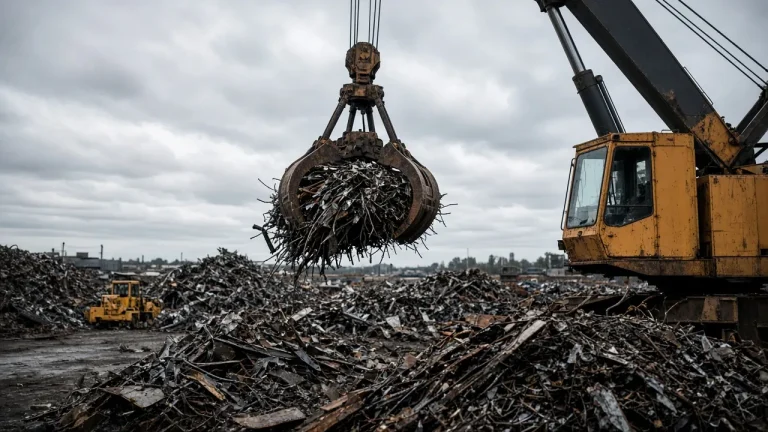
Scrap is the main input for the EAF route: about 710 kg per tonne, plus 586 kg of iron ore (often as DRI or pig iron) and 2.3 GJ of electricity (worldsteel). Blast furnace converters also use some scrap, about 125 kg per tonne on average and up to about 30% of the charge (worldsteel fact sheet). Scrap substitutes for virgin materials: worldsteel says each tonne of scrap recycled saves about 1.4 t of iron ore, 740 kg of coal and 120 kg of limestone (steelFacts). Scrap prices depend on collection, which follows economic activity, and increasingly on export rules.
Why it matters commercially
From raw materials to a tonne of steel
The table applies worldsteel’s average input ratios to a hypothetical $10/t move in each raw material. It is a simplification: it ignores ore grade, coke yields, freight, energy and the fact that mills buy on different contract terms.
| Raw material | Use per tonne of crude steel | Cost change from a $10/t move |
|---|---|---|
| Iron ore (BF-BOF) | 1,370 kg | ≈ $13.70/t |
| Metallurgical coal (BF-BOF) | 780 kg | ≈ $7.80/t |
| Scrap (BF-BOF) | 125 kg | ≈ $1.25/t |
| Scrap (scrap-EAF) | 710 kg | ≈ $7.10/t |
| Iron ore / DRI / pig iron (scrap-EAF) | 586 kg | ≈ $5.86/t |
Two practical conclusions follow. Analysis First, for a blast furnace mill, a simultaneous $10/t rise in ore and coal adds roughly $21–22/t to the input cost. That is a meaningful amount, but small next to the hundreds of euros per tonne that finished flat steel trades at. Second, EAF costs track scrap and electricity. When scrap is expensive relative to ore, blast furnace producers gain a cost advantage, and the reverse also holds. Our raw materials update tracks that spread.
Why pass-through is slow and partial
- Inventories and contract terms. Mills hold weeks of raw material stock and often buy on monthly or quarterly index formulas, so changes reach their costs with a delay.
- Demand sets the margin. In a weak market, mills absorb raw material increases; in a strong market, they can pass on more than the cost change.
- Trade rules and energy. In Europe, import quotas and power and gas prices can move finished-steel prices more than ore or coal do.
- Big swings do feed through. The 2021 iron ore peak of $214.43/t in the World Bank series coincided with record steel prices. Our view is that large, sustained moves matter; week-to-week noise usually does not.
Who is affected
Buyers on index-linked contractsPass-through Contracts with raw-material clauses pass on changes faster; check the formula and the lag.
Buyers of EAF products (rebar, sections)Scrap and power Prices tend to follow scrap and electricity more than ore and coal.
Buyers of blast-furnace flat steelOre and coal Ore and coal moves set the cost floor for integrated mills.
Traders and stockholdersInventory risk Falling raw material costs can undercut the value of stock bought earlier.
Stay ahead of the steel market
What to watch next
- Simandou ramp-up and port commissioning (Q1 2027): a large new source of high-grade ore.
- Chinese steel output in monthly worldsteel data: the biggest single driver of ore demand.
- EU scrap export rules for non-OECD destinations, which may change scrap flows from 2027.
- Coking coal supply disruptions, such as weather or logistics problems at major export hubs, which can move prices quickly.
Verification status: Verified
- Input ratios, recycling savings and production shares were checked against worldsteel publications; the iron ore price history against the World Bank Pink Sheet monthly data (series to December 2025); the Simandou figures against SIMFER. Per-tonne sensitivities are Loharo calculations from those ratios, and are simplified as described.
- Key: Verified = every factual claim checked against a primary source; Partially verified = core facts confirmed, some figures from secondary/market sources; Analysis = interpretation; Developing = story still moving.
Ask the Analyst
“1,000 t HRC from China into Rotterdam at €540/t CFR”: landed cost with duty, quota and CBAM in one answer.Ask the AnalystSources
Primary sources
- Raw materials — World Steel Association, accessed 11 October 2026
- Fact sheet: Steel and raw materials — World Steel Association, 2023
- steelFacts — World Steel Association, 2023
- World Steel in Figures 2026 — World Steel Association, 2026
- Commodity Markets (Pink Sheet): monthly prices — World Bank, monthly series, accessed 11 October 2026
- SIMFER advances the Simandou project at pace — SIMFER, 2026
Information as of 16 October 2026. This is an evergreen explainer: figures are dated and linked to their sources, and calculations state their assumptions. Prices quoted from third-party assessments are attributed to the publisher that reported them; Loharo does not publish its own price assessments. This article is market intelligence, not investment, legal or tax advice.