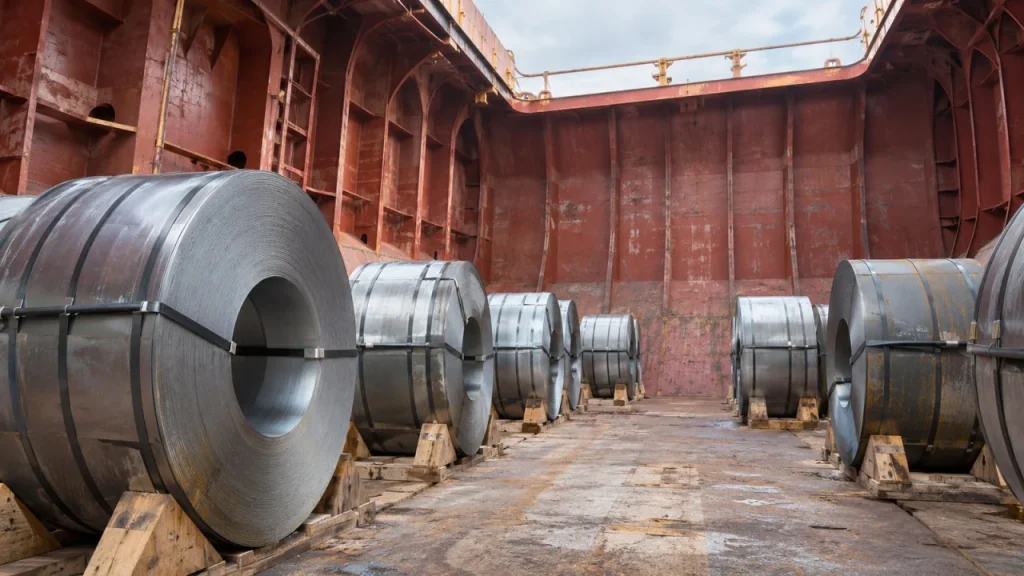
China shipped 2.91 million tonnes of steel abroad in the week to 2 November, its strongest week in 13 weeks, Mysteel’s ship-tracking data show, while Chinese hot-rolled coil traded for export at $478–485 a tonne FOB. For EU buyers that coil is still not a cheap option: with the “other countries” hot-rolled quota used up, Loharo’s working puts it at about €656–800 a tonne after EU duties but before freight and CBAM, against about €750–760 for Northern European mill coil. The step now: do not plan Q1 coil around Chinese offers; if an Asian trader quotes unusually cheap coil from a third country, ask for the melt-and-pour country on the mill certificate before you commit.
What the data show
In its 4 November evening round-up (Mysteel, in Chinese), Mysteel said China’s steel export shipments for 27 October–2 November totalled 2.907 million tonnes, up 562,200 tonnes (24.0%) on the previous week and 454,800 tonnes (18.5%) on the same week a year earlier. Global steel arrivals at ports rose 18% week on week to 6.70 million tonnes. These are Mysteel’s vessel-tracking estimates, not customs figures.
Reach steel buyers and importers worldwide
Put your brand in front of the people who buy and trade steel.
Advertise with LoharoPrices did not rise with the volumes. Shanghai Metals Market said Chinese hot-rolled coil export deals on 4 November were concentrated at $478–485 a tonne, with second-tier exporters near $475 (SMM). Mysteel’s weekly export report for 26–30 October put private-mill offers at $480–490 FOB and major mills at $495–500, with buyers bidding around $490 (Mysteel, in Chinese). The gap is one of basis: SMM reports transaction levels, Mysteel quotes offers, and the major-mill figure includes premium sources such as Bayuquan. We use SMM’s deal range below.
This week’s jump sits alongside Mysteel’s October survey, which showed export orders still growing while home orders slumped (Loharo, 4 November). One strong week is not a trend, and China’s official October customs figures are still to come.
Loharo calculation: what Chinese coil costs at the EU border
Analysis. At the ECB reference rate of $1.1267 per euro on 4 November (ECB), $478–485 is about €424–430 a tonne FOB. Chinese hot-rolled coil then meets three EU charges. First, the 50% out-of-quota duty, because the “other countries” hot-rolled pool has been used up since 1 October (Loharo quota tally). Second, anti-dumping and countervailing duties extended in June 2023 for five years: the anti-dumping rate is 0% for most exporters, 10.3–31.3% for some named mills, and the countervailing rate is 35.9% for “all other companies” and 4.6–31.5% for named mills (Regulation (EU) 2023/1122; Hong Kong Trade and Industry Department register, 30 June 2026). Third, CBAM certificates, which depend on each mill’s emissions and which we leave out here.
| Step | Low case (lowest listed duty, 4.6%) | Residual case (35.9%) |
|---|---|---|
| FOB price, $478–485 at 1.1267 | €424–430 | €424–430 |
| + 50% out-of-quota duty | +€212–215 | +€212–215 |
| + countervailing duty | +€20 | +€152–155 |
| = before freight, insurance and CBAM | €656–666 | €789–800 |
| Northern Europe mill coil, ex-works | €750–755 (SMM, 4 Nov) | €760 (Eurometal, 30 Oct) |
Working: 478 ÷ 1.1267 = 424.25; × 1.5 = 636.37; × 1.546 = 655.89 (low case) or × 1.859 = 788.68 (residual case); the same for 485 gives 430.46, 665.49 and 800.23. We assume the duties stack on the same value and use FOB as a stand-in; real customs value is CIF, so the true duty is a little higher. In the low case, about €84–99 a tonne is left to cover sea freight, insurance, port costs and CBAM; in the residual case there is no gap at all.
Three views
- Buyer: Chinese coil is not a realistic Q1 alternative for most EU buyers. The pressure from the export surge is indirect: Chinese tonnes compete with Indian, Turkish and Vietnamese coil in third markets, which can make those origins keener on price for the EU quota room they still hold.
- EU mill: Eurometal reports the EU coil market as bullish for Q1 restocking (Eurometal), and SMM notes that higher EU prices would make already-landed import stock easier to sell (SMM).
- Trader or service centre: the risk is paperwork. Since 1 October the melt-and-pour country decides which quota applies, so a coil melted in China and rolled elsewhere could land in the wrong pool and pay 50%.
What would change this view: a quota-free route for Chinese steel (for example via semi-finished slab rolled in the EU), a sharp drop in freight rates, or a fall in Northern European prices towards €650.
What EU buyers should do
Base Q1 coil budgets on EU mill and quota-holding origins, not on Chinese FOB prices. For any Asian or third-country offer, ask for the melt-and-pour country and heat number on each mill certificate before signing, as required under the new regime since 1 October.
Stay ahead of the steel market
What to watch
- Around 7–9 November: China’s October customs export total. Above about 10 million tonnes would confirm the weekly surge.
- Early January: the Q1 2027 quota reset, when first-come quota room for other origins opens again.
- Weekly: Northern European HRC. Below about €700 ex-works, the low-duty Chinese case starts to look competitive.
Verification status: Verified
- Shipment figures are Mysteel vessel-tracking estimates (4 November, read in Chinese); export prices from SMM (4 November) and Mysteel (30 October), with their different bases explained; EU prices from SMM and Eurometal; duty rates from the EU regulation and the Hong Kong TID register; the exchange rate is the ECB reference rate. The border-cost table is a Loharo calculation that leaves out freight and CBAM.
- Key: Verified = material factual claims are supported by an appropriate primary source or clearly attributed reporting/market assessments; Partially verified = a specific material claim remains unsupported, contradicted or materially overstated; Analysis = interpretation or forecast with sourced premises; Developing = material facts are checked but the situation is still changing.
Ask the Analyst
“1,000 t HRC from China into Rotterdam at €540/t CFR”: landed cost with duty, quota and CBAM in one answer.Ask the AnalystSources
Primary sources
- Mysteel evening round-up: China steel export shipments, 27 Oct–2 Nov (in Chinese) — Mysteel, 4 November 2026
- Commission Implementing Regulation (EU) 2023/1122 — anti-dumping duty on hot-rolled flat products from China — European Commission, 7 June 2023
- Euro foreign exchange reference rate, USD — European Central Bank, 4 November 2026
Supporting sources
- [SMM Steel] Chinese HRC export prices — Shanghai Metals Market, 4 November 2026
- Mysteel weekly: China steel export prices, 26–30 October (in Chinese) — Mysteel, 30 October 2026
- EU HRC: distributors de-stock amid weak demand — Shanghai Metals Market, 4 November 2026
- European coil and green steel round-up — Eurometal, 30 October 2026
- EU anti-dumping and countervailing measures against products from Chinese mainland (position at 30 June 2026) — Hong Kong Trade and Industry Department
Related on Loharo
- China’s steel PMI falls to 43.0 as home orders slump, but export orders keep growing
- EU steel quotas four weeks into Q4: 65 of 283 lines used up
Last fact-check: 5 November 2026.
Planning steel imports into the EU? Estimate CBAM costs with the free calculator using EU default values. For supplier-specific emissions and a portfolio review, see the CBAM Cost Check.