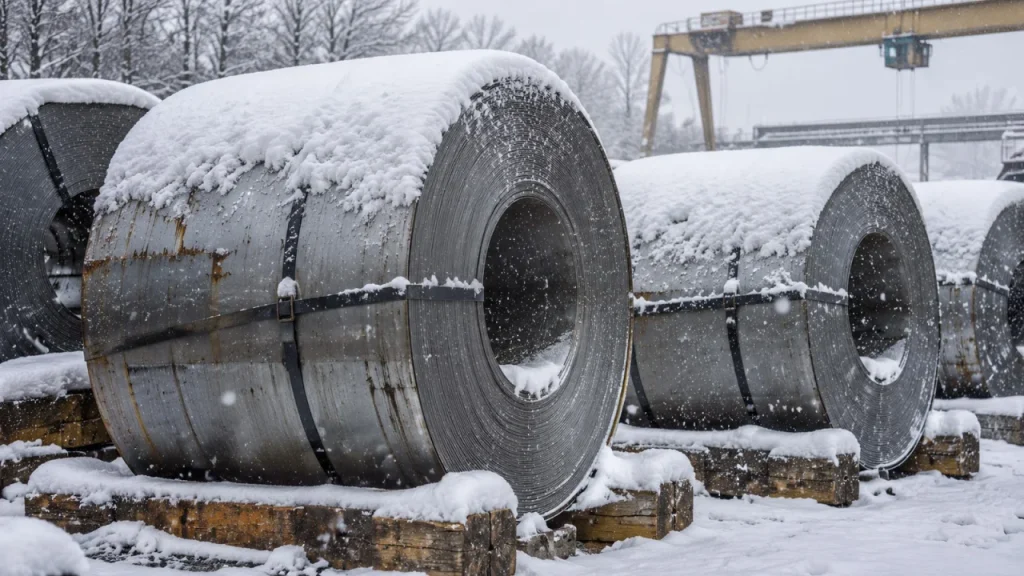
Indian hot-rolled coil offered into Northern Europe rose by $10 a tonne in a week to $740 CFR, Shanghai Metals Market (SMM) reported on 11 November, while its Europe-bound FOB assessment held at $660 on 12 November. For EU flat-steel buyers this coil is now a Q1 2027 option, because India’s Q4 hot-rolled quota is almost used up. On Loharo’s working it undercuts Northern European mill coil by about €97–103 a tonne before CBAM, but on EU default values CBAM turns that into a premium of about €213–218. The step now: before booking Indian coil for January clearance, ask the mill for verified installation emissions and price the offer both ways.
What the reports say
SMM put Indian HRC for Europe at $660 a tonne FOB on 11 November, with some suppliers quoting $680, up from $650 on 6 November (SMM, 11 November; SMM, 6 November). It said firmer European prices and tighter import availability encouraged the higher quotes, but buyers resisted them. On 12 November it reported the FOB level unchanged (SMM, 12 November). In its European report SMM put Northwest European coil at €768 ex-works and said that, with India left with only about 3,000 tonnes of Q4 quota, import offers now target Q1 clearance (SMM, 11 November). Fastmarkets’ Northern Europe ex-works index was €762.50 on 10 November, as relayed by EUROMETAL.
Reach steel buyers and importers worldwide
Put your brand in front of the people who buy and trade steel.
Advertise with LoharoThe quota figure checks out. The Commission’s TARIC database shows India’s hot-rolled flat line (order 09.9803) with 2,991 of 152,310 tonnes left this quarter; at the last allocation, on 8 October, only 44% of the quantities requested could be granted, and about 1,487 tonnes await allocation (TARIC, order 099803). Outside the quota, a 50% duty applies (Regulation (EU) 2026/1384).
Loharo calculation: Indian coil against EU mill coil in Q1 2027
Analysis. Coil cleared from January falls in CBAM import year 2027: the CBAM factor is 95% and default values carry a 20% mark-up. India’s default for CN 7208 is 4.28 tCO₂e/t and the benchmark is 1.370 (Implementing Regulation (EU) 2026/1740; 2025/2620). We hold the certificate price at the latest published €82.32 (European Commission, Q3 2026); 2027 prices will be weekly and are not yet known. Exchange rate: $1.1127 per euro (ECB, 11 November).
| Scenario, per tonne | Indian coil, $740 CFR = €665.05 | Against €762.50–768 EU ex-works |
|---|---|---|
| In quota, no CBAM (reference only) | €665.05 | €97–103 cheaper |
| In quota, verified emissions equal to the 1.370 benchmark: + €5.64 | €670.69 | €92–97 cheaper |
| In quota, EU default value: + €315.70 | €980.75 | €213–218 dearer |
| Out of quota: + 50% duty (€332.52), before CBAM | €997.57 | €230–235 dearer |
Break-even: Indian coil matches the EU price, before port and inland costs, only if its verified emissions stay below about 2.5 tCO₂e/t: (97.45 ÷ 82.32) + 1.3015 = 2.49 against €762.50, or 2.55 against €768. Each €10 change in the certificate price moves the default case by about €38 a tonne.
The comparison is not fully like-for-like: CFR excludes unloading, clearance and delivery to the buyer, while ex-works excludes the mill’s delivery charge. SMM’s FOB and CFR figures together imply about $80 a tonne for sea freight and insurance, if both refer to the same cargoes; that is our inference, not a freight assessment.
What it means for buyers
Buyer: the price edge depends on supplier data, not on the CFR quote. Write into the contract which emissions value is used and who carries the CBAM cost if verified data do not arrive. EU mill: while importers price on defaults, the Indian offer is unlikely to cap Q1 mill targets. Trader or service centre: Q1 quota is first come, first served from 1 January, so a late vessel risks the 50% duty.
What would change this view: a weaker or stronger euro, a 2027 certificate price away from €82, or verified Indian data near or below 2.5 tCO₂e/t. Next watch: the Commission’s weekly quota reports and the Q1 opening on 1 January 2027.
Verification status: Verified
Indian and EU prices are SMM and Fastmarkets market assessments, attributed as such; SMM’s quota remark matches the Commission’s TARIC balance. CBAM inputs come from EUR-Lex and the Commission, the exchange rate from the ECB; the scenario table and break-even are Loharo calculations, not a customs liability.
Ask the Analyst
“What could CBAM add to Indian HRC delivered to Rotterdam in 2027?”: landed cost with duty, quota and CBAM in one answer.Ask the AnalystSources
Primary sources
- Indian domestic HRC remains stable as Europe-bound export offers firm — SMM, 11 November 2026; Indian HRC and billet prices remain stable — SMM, 12 November 2026; Indian HRC prices hold firm ahead of Diwali — SMM, 6 November 2026
- EU HRC holds at highs as buyers resist mills’ Q1 targets — SMM, 11 November 2026
- European HRC prices firm on reduced imports, higher energy and transport costs — EUROMETAL, relaying Fastmarkets, 10 November 2026
- TARIC quota 099803, India, hot-rolled flat (category 1A) — European Commission, DG TAXUD, checked 12 November 2026
- Implementing Regulation (EU) 2026/1740 (default values), Implementing Regulation (EU) 2025/2620 (benchmarks) and Directive (EU) 2023/959 (CBAM factors); Regulation (EU) 2026/1384 (tariff quotas, 50% out-of-quota duty) — EUR-Lex
- Price of CBAM certificates — European Commission; Euro reference rate, US dollar — ECB, 11 November 2026
Supporting sources
- Steel Trade Measures Tracker and free CBAM calculator — Loharo, checked 12 November 2026
Last fact-check: 12 November 2026. Market intelligence, not legal or investment advice.