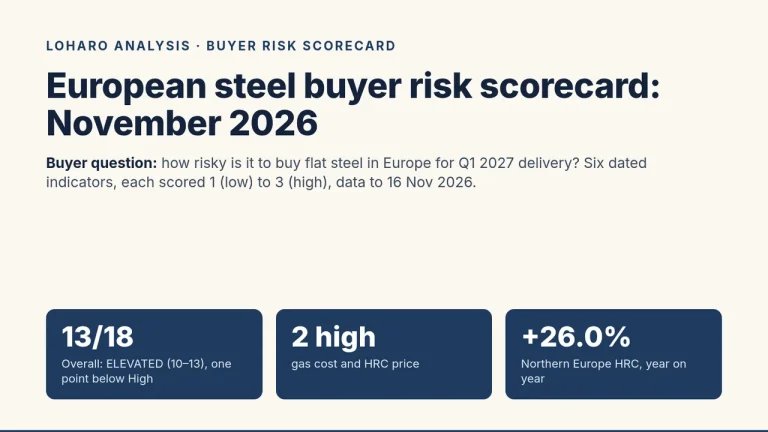
Germany’s national steel summit in Salzgitter on 16 November brought a demand, not a decision: steel companies, the IG Metall union and the 11 German states with steel sites handed economy minister Katherina Reiche a position paper asking for a competitive, predictable industrial power price (dpa, via Handelsblatt). For EU buyers of German and northern European rebar, wire rod and other electric-furnace steel, nothing changes in prices yet. On Loharo’s working, the power subsidy already in place is worth only about €8–12 per tonne of electric-furnace steel, and it is paid in 2027. The step now: before you accept December or first-quarter long-product offers that carry November’s €70–90 a tonne rises, ask the mill whether its price or energy surcharge follows spot power. German day-ahead power has fallen from an average of €275/MWh in 1–10 November to about €195–203/MWh since.
What happened in Salzgitter
The summit met at Salzgitter AG’s plant with Reiche, the steel association Wirtschaftsvereinigung Stahl, IG Metall and the states’ “steel alliance”. “Electricity is a key factor for low-emission steel production,” the position paper says; industry representatives added that actual German power prices are “far away” from a competitive, predictable level, and called for lead markets for green steel and trade protection. More than 2,000 steelworkers demonstrated beforehand, according to the union (dpa). IG Metall’s deputy chair Jürgen Kerner said before the meeting that the industrial power price, in its current form, is still not enough (produktion.de, citing dpa). The dpa report from the summit did not mention any new federal decision. The economy ministry’s ten-point hydrogen package, with at least €1.5 billion for companies that switch production to hydrogen, is not new: it was presented on 19 October (tagesschau).
Reach steel buyers and importers worldwide
Put your brand in front of the people who buy and trade steel.
Advertise with LoharoWhat the existing power subsidy is worth
Germany’s industrial power price (Industriestrompreis) runs for 2026–2028. According to the federal office that pays it, BAFA, the 2026 reference price is €87.44/MWh; the relief is half of that, capped so the company still pays at least €50/MWh, which gives €37.44/MWh for 2026. Only 50% of a site’s eligible consumption qualifies, recipients must invest at least half of the aid in decarbonisation, and applications for 2026 open in January 2027 with a 31 March 2027 deadline (BAFA).
Analysis Loharo calculation: €37.44/MWh on half the consumption is €18.72 per MWh used. Electric arc furnaces use about 400–500 kWh per tonne of steel (Journal of Sustainable Metallurgy); worldsteel puts the whole scrap-based route at 2.3 GJ, or about 640 kWh, per tonne (worldsteel). At 450 kWh/t the relief is 18.72 × 0.45 = €8.42/t; at 640 kWh/t it is €11.98/t, for a mill whose site qualifies. That is small next to the move in spot power, and it arrives a year late.
Loharo calculation: has the rebar rise outrun power costs?
| German day-ahead power, average | €/MWh | Melting power at 450 kWh/t | At 640 kWh/t | Change vs October 2026 (450 / 640 kWh/t) |
|---|---|---|---|---|
| October 2025 | 84.40 | €38/t | €54/t | −€38 / −€54 |
| October 2026 | 169.27 | €76/t | €108/t | — |
| 1–10 November 2026 | 274.91 | €124/t | €176/t | +€48 / +€68 |
| 11–15 November 2026 | 202.97 | €91/t | €130/t | +€15 / +€22 |
| 16 November 2026 | 194.49 | €88/t | €124/t | +€11 / +€16 |
| Industriestrompreis relief, 2026 | −18.72 (effective) | −€8/t | −€12/t | paid in 2027 |
Analysis German mills raised rebar base prices in two steps by €70–90/t in the two weeks to 7 November, from €410–430/t a month earlier to around €500/t, and also lifted the wire mesh surcharge by €25/t from 1 November, Kallanish reported; a distribution buyer said energy was the mills’ main argument (Kallanish via Eurometal). Fastmarkets assessed northern European rebar at €740/t delivered on 11 November, up from €660–700/t the week before (Fastmarkets via Eurometal). Like for like, the base-price rise is measured against early October, so compare it with October power: even at the 1–10 November peak, spot melting power was only €48–68/t above October, and at prices since 11 November about €11–22/t. Against October 2025 the gap is wider (+€86–122/t at the peak, +€53–76/t since 11 November), so part of the rise recovers a year of higher power costs that mills had not passed on. The table does not show mills’ actual costs, which depend on hedging and scrap, but it does show that the spot argument has weakened since the second price step.
What has changed since our 11 November report
Our report on Italian mill halts showed German day-ahead power at €274.91/MWh in 1–10 November, close to northern Italy’s €281.05. Since then German prices have eased: 11–15 November averaged €202.97/MWh, which on the same working takes about €32–46/t off the cost of melting a tonne compared with the first ten days of the month. Daily prices remain volatile (€351.48/MWh on 10 November, €139.70 on 15 November), so one week is not a trend.
What this means for buyers
Analysis Imports offer little relief on rebar. In the EU tariff quota, Türkiye’s fourth-quarter rebar line (09.9884) has been used up since 1 October, China’s (09.9888) has 25 t left, Algeria’s (09.9886) 988 t, Egypt’s (09.9885) 14,353 t of 36,159 t and the other-countries line (09.9614) 12,222 t of 15,831 t (TARIC, read 16 November; see Loharo’s Tracker); out-of-quota imports pay 50%. Turkish rebar is also firm on scrap costs, as we reported in our 9 November report.
- Fixed-price December or Q1 offers: ask the mill to show which part of the November rise is energy, and whether it falls if spot power stays near €200/MWh.
- Energy-surcharge contracts: check which index and period the surcharge uses (day-ahead monthly average or forward), and when it resets; a monthly day-ahead index would reflect November’s lower second half.
- Do not price in the summit: no new relief has been announced, and the 2026 Industriestrompreis is paid only from 2027.
Stay ahead of the steel market
What to watch
- Federal follow-up to the position paper: any change to the Industriestrompreis rules or grid charges for 2027.
- German day-ahead prices on Energy-Charts: a return above €250/MWh would restore the mills’ cost argument.
- Fastmarkets’ next weekly rebar assessment (the last was on Wednesday 11 November) and mills’ December base prices.
- 1 January 2027: new quarterly tariff quotas open, including Türkiye’s rebar line.
Verification status: Verified
- The summit facts come from dpa’s report and IG Metall’s comments as reported by produktion.de; the scheme figures from BAFA’s official page; the power prices from Energy-Charts data; quota balances from TARIC. Rebar prices are attributed to Kallanish and Fastmarkets as reported by Eurometal; the per-tonne figures are Loharo calculations with inputs shown.
- Key: Verified = material factual claims are supported by an appropriate primary source or clearly attributed reporting/market assessments; Partially verified = a specific material claim remains unsupported, contradicted or materially overstated; Analysis = interpretation or forecast with sourced premises; Developing = material facts are checked but the situation is still changing.
Sources
Primary sources
- Industriestrompreis (industrial power price): scheme page, 2026 reference and difference price, eligibility and deadlines, Federal Office for Economic Affairs and Export Control (BAFA), read 16 November 2026
- Day-ahead spot prices, Germany–Luxembourg bidding zone, Energy-Charts (Fraunhofer ISE), October 2025, October 2026 and 1–16 November 2026, read 16 November 2026
- TARIC quota details, Q4 2026 rebar lines 09.9884 Türkiye, 09.9888 China, 09.9885 Egypt, 09.9886 Algeria and 09.9614 other countries, European Commission (DG TAXUD), read 16 November 2026
- Raw materials, worldsteel
Supporting sources
- Stahlgipfel: Branche dringt auf Entlastung beim Strompreis, Handelsblatt (dpa), 16 November 2026
- Nationaler Stahlgipfel in Salzgitter: Branche fordert konkrete Entscheidungen für grünen Stahl, produktion.de, November 2026
- Reiche verspricht Milliarden für Wasserstoff-Ausbau, tagesschau, 19 October 2026
- German rebar prices take another leap, Eurometal (Kallanish), 7 November 2026
- Italian rebar prices stable amid weak demand, high costs; German prices rise, Eurometal (Fastmarkets), 13 November 2026
- Electric arc furnace energy use, Journal of Sustainable Metallurgy
Last fact-check: 16 November 2026.
Planning steel imports into the EU? Estimate CBAM costs with the free calculator using EU default values. For supplier-specific emissions and a portfolio review, see the CBAM Cost Check.