Which origin needs a customs check before you commit?
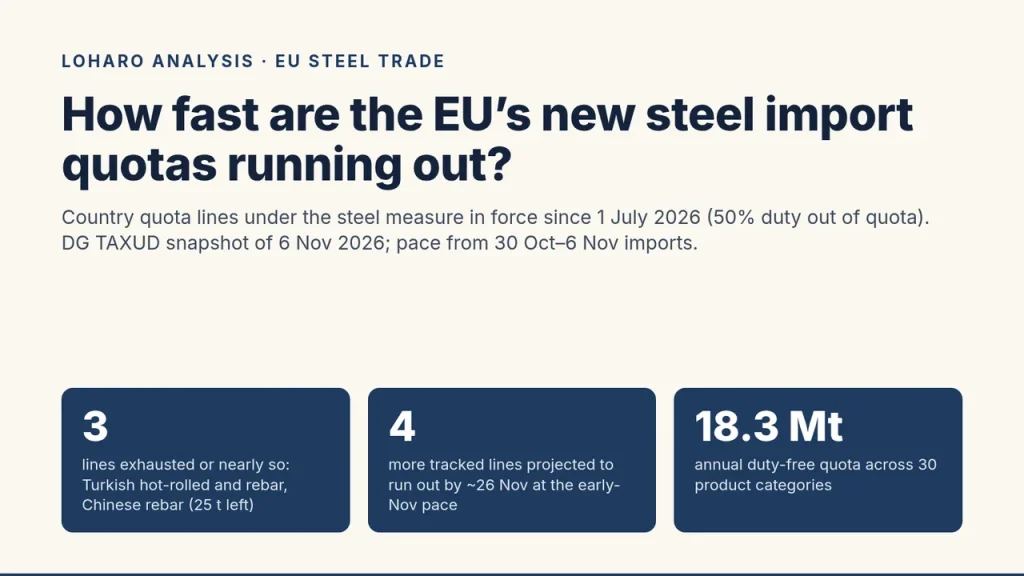
The EU’s new steel measure replaced the old safeguard on 1 July 2026: 18.3 Mt a year of duty-free quota across 30 categories, with a 50% duty above quota. The category totals still show room, but the Commission’s 6 November snapshot, published on 9 November, shows Turkish hot-rolled and rebar exhausted, Chinese rebar down to 25 t, and four more country lines on course to close by late November. Confirm the product, origin and order number in TARIC before committing.
Reach steel buyers and importers worldwide
Put your brand in front of the people who buy and trade steel.
Advertise with Loharo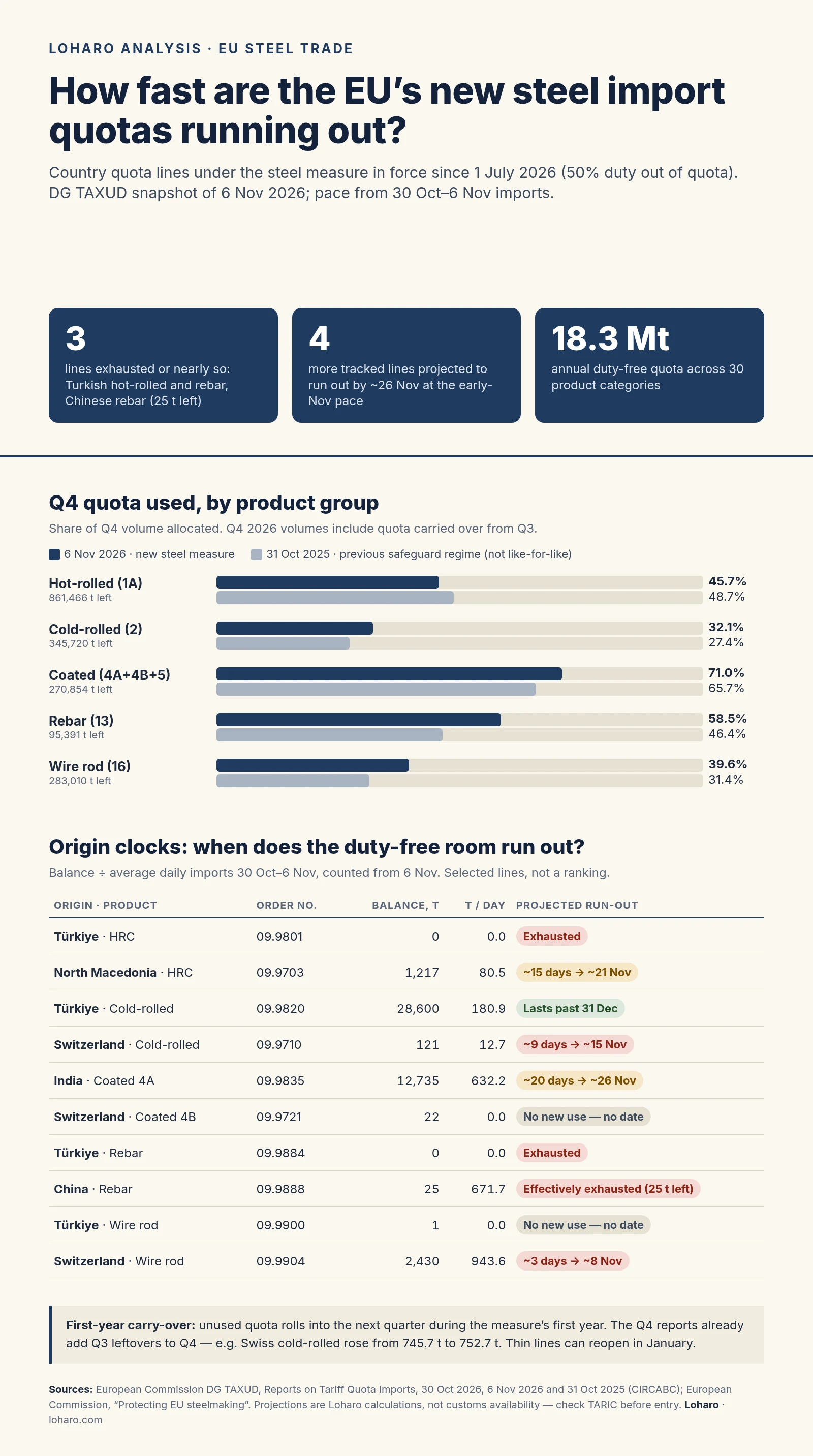
| Origin · product | Order | Balance, t | t/day | Run-out from 6 Nov |
|---|---|---|---|---|
| Türkiye · hot-rolled | 09.9801 | 0 | — | Exhausted |
| North Macedonia · hot-rolled | 09.9703 | 1,217 | 80.5 | ~15 days (~21 Nov) |
| Türkiye · cold-rolled | 09.9820 | 28,600 | 180.9 | Past 31 Dec |
| Switzerland · cold-rolled | 09.9710 | 121 | 12.7 | ~9 days (~15 Nov) |
| India · coated 4A | 09.9835 | 12,735 | 632.2 | ~20 days (~26 Nov) |
| Switzerland · coated 4B | 09.9721 | 22 | 0 | No new use, no date |
| Türkiye · rebar | 09.9884 | 0 | — | Exhausted |
| China · rebar | 09.9888 | 25 | 671.7 | Effectively exhausted |
| Türkiye · wire rod | 09.9900 | 1 | 0 | No new use, no date |
| Switzerland · wire rod | 09.9904 | 2,430 | 943.6 | ~3 days (~8 Nov) |
Read the clock, not the category
Analysis: India’s coated 4A line shows the method: 12,735 t left ÷ (4,426 t imported in seven days ÷ 7) ≈ 20 days, or about 26 November. Its pace slowed from 10,913 t a week earlier. We use the rise in Import Amount, not the fall in Balance, because added quota can lift a balance. Where nothing new was imported, as on Türkiye’s wire-rod and Switzerland’s coated 4B lines, there is no reliable date. Swiss wire rod was due to close around 8 November and may already be shut.
Switzerland’s cold-rolled line looks odd but is right: its Q4 quota is only 752.7 t, so 632 t used is 84.0%, leaving 121 t.
First-year carry-over changes the picture
In the measure’s first year, unused quota carries over to the next quarter. The Q4 reports already show it: Q3 balances were zeroed and added to Q4 volumes, lifting Türkiye’s cold-rolled quota by about 2,025 t and Switzerland’s by 7 t. Our category percentages are measured against those enlarged Q4 volumes. A line that closes in November may reopen in January with fresh quota plus any leftovers.
The 2025 comparison bars come from the previous safeguard regime, with different country allocations and no first-year carry-over. They give context, not a like-for-like trend.
Three commercial perspectives
Buyer: get an all-in alternative quote before relying on a thin balance, and agree who pays a 50% out-of-quota duty. Mill: a closed line can firm up offers, but it is not a booked order. Trader/service centre: time arrivals for January if an origin closes, and check the order balance against shipment size.
What would change this view: a faster or slower clearance pace, corrections or a new allocation. Next check: the 13 November report. These clocks were re-run on 10 November with the 6 November report.
Earlier coverage: the Q4 quota position four weeks in and the steel trade measures tracker.
Verification status: Verified
All balances and run rates were recomputed from the 30 October and 6 November workbooks; regime facts were checked against the Commission. Clocks are Loharo calculations, not a clearance guarantee.
Ask the Analyst
“Is there quota room for Turkish HRC entering the EU this quarter?”: landed cost with duty, quota and CBAM in one answer.Ask the AnalystSources
Primary sources
- Report on Tariff Quota Imports — 6 November 2026 — European Commission, DG TAXUD, 2026-11-06
- Report on Tariff Quota Imports — 30 October 2026 — European Commission, DG TAXUD, 2026-10-30
- Report on Tariff Quota Imports — 31 October 2025 — European Commission, DG TAXUD, 2025-10-31
- Protecting EU steelmaking — European Commission, accessed 2026-11-10
- Steel overcapacity: Council greenlights new rules — Council of the EU, 2026-06-08
Last fact-check: 10 November 2026 (latest DG TAXUD snapshot: 6 November 2026).