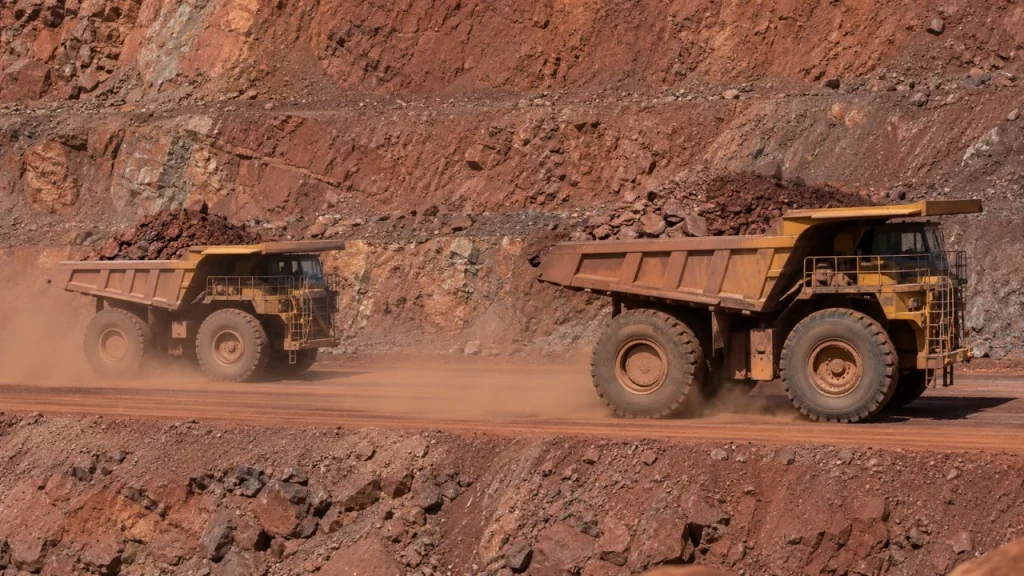
Iron ore is at its cheapest in four years, and China’s state buyer is pressing for lower still. Singapore iron ore futures slipped below $90 a tonne this week, the lowest in four years, Reuters reported (Reuters via Investing.com), and traded at $87.75 on 18 November, more than a fifth below the mid-May peak (Bloomberg via The Edge). For EU buyers of blast-furnace flat steel, that is a real but small cost cut for their suppliers: on Loharo’s calculation at the futures price, the fall since May takes at least €27 off the ore bill per tonne of crude steel, much less than the €100–150 a tonne that Northwest European mills have been asking for 2027 contracts. The step for buyers: in 2027 contract talks, ask what raw-material basis the mill’s price tracks, and don’t expect cheap ore to pay for a price cut.
What changed in Asia
- China’s buyer is squeezing the miners. China Mineral Resources Group (CMRG), the state-backed body that now negotiates much of China’s ore buying, banned steelmakers from buying specific BHP, Fortescue and Rio Tinto products while this year’s annual supply talks were under way, Reuters reported. CMRG has since reached new deals with BHP and Rio Tinto; Fortescue has warned its operations could be affected if talks do not conclude by year-end (Reuters via Investing.com).
- Talks in Beijing today. BHP and Rio Tinto executives are due to meet Premier Li Qiang and Chinese business leaders at a CEO roundtable in Beijing on 20 November with Australia’s prime minister, according to the Business Council of Australia (Reuters; SteelOrbis).
- Analysts see room to fall. Researchers at Mysteel and at CMRG both pointed to about $80 a tonne as the level where high-cost mines would start cutting output; Mysteel puts the 90th-percentile mine cost at $83.02. Goldman Sachs, using a different method, sees cost support around $85 (Bloomberg via The Edge; Mining.com.au). Goldman also expects CMRG’s influence on prices to grow (Reuters).
On 11 October Loharo reported seaborne ore just under $90 (Scrap and iron ore send soft signals). What is new since then: the four-year low, CMRG’s product bans, today’s Beijing meeting and analysts naming $80 as the next floor. Our raw-materials primer explains why changes in ore prices reach finished-steel prices slowly and only in part. This piece applies that method to the 2027 contract round.
Reach steel buyers and importers worldwide
Put your brand in front of the people who buy and trade steel.
Advertise with LoharoLoharo calculation: what the ore fall is worth per tonne of steel
Inputs: worldsteel’s average of 1,370 kg of iron ore and 780 kg of metallurgical coal per tonne of crude steel on the blast-furnace route (worldsteel); the ECB reference rate of $1.0992 per euro on 19 November (ECB). A fall of more than 20% to about $88 means the May peak was at least $110, so we use $110 as the lower bound of the May level.
| Ore price scenario | Ore, $/t | Ore cost per t crude steel ($) | Same in € | Change vs May |
|---|---|---|---|---|
| May peak (lower bound) | $110 | $151 | €137 | — |
| Midpoint | $100 | $137 | €125 | −€12 |
| Now (18 Nov) | $88 | $121 | €110 | −€27 |
| Analysts’ floor | $80 | $110 | €100 | −€37 |
Set against Europe’s price round, the saving is small. Northern European HRC offers rose €10 to €760–780 a tonne ex-works this week, and mills say they are confident of higher first-quarter prices (World Steel Dynamics via GMK Center). In late October, Northwest European mills were seeking €100–150 a tonne more for 2027 contracts, while the market expected about €50–80 (EUROMETAL). On our figures, at least €27 a tonne of ore savings covers 18–27% of the mills’ ask and 34–55% of the expected settlement. Ore at today’s price is about €110 per tonne of crude steel, roughly 14% of a €770 coil. Coal is the bigger block: premium hard coking coal at $262.6 a tonne FOB Australia on 6 November (Kallanish via GMK Center) works out at about $205 (€186) per tonne of crude steel at worldsteel’s ratio.
Three limits apply, and they are Loharo’s assessment. The Singapore contract is a China-delivered fines price, while European mills buy Brazilian, Canadian and Swedish fines and pellets under their own index-linked contracts, often with a lag and pellet premiums. Coil also needs more than one tonne of crude steel per tonne shipped. And EAF mills, which make about 30% of the world’s steel, mostly feel scrap and power costs, not ore.
What this means for buyers
For buyers of blast-furnace HRC and coated coil, cheaper ore is a negotiating point, not a reason to expect lower prices. Power, carbon costs and tighter import quotas are what is pushing European offers up.
In 2027 contract talks, ask the mill which raw-material indices or surcharges its price follows. If a formula passes ore increases through, ask for decreases to pass through on the same terms. Bring the number: at least €27 per tonne of crude steel since May.
Buyers of EAF long products gain little from this: their suppliers’ costs follow scrap and electricity.
Stay ahead of the steel market
What to watch
- The outcome of today’s Beijing roundtable, and whether Fortescue reaches a deal with CMRG before year-end.
- Whether futures break towards the $80–85 range that Chinese analysts and Goldman see as cost support, as supply from Guinea’s Simandou mine grows (Bloomberg via The Edge).
- Futures and physical prices are different bases: Singapore futures are financial contracts, while 62% Fe CFR Qingdao assessments price delivered ore (SteelPrices). Check which one a supplier’s formula uses.
Verification status: Verified
- Prices, CMRG’s actions and the analysts’ floors are attributed to Reuters, Bloomberg (via The Edge and Mining.com.au), Kallanish and World Steel Dynamics (via GMK Center) and EUROMETAL; input ratios are from worldsteel and FX from the ECB. The per-tonne figures are Loharo calculations with the inputs shown, and the May level is a lower bound derived from the reported fall of more than 20%.
- Key: Verified = material factual claims are supported by an appropriate primary source or clearly attributed reporting/market assessments; Partially verified = a specific material claim remains unsupported, contradicted or materially overstated; Analysis = interpretation or forecast with sourced premises; Developing = material facts are checked but the situation is still changing.
Sources
Primary sources
- worldsteel, Raw materials (BF-BOF inputs per tonne of crude steel)
- European Central Bank, euro reference rate USD, 19 November 2026
Supporting sources
- Reuters via Investing.com, “BHP, Rio Tinto executives to meet China leaders as iron ore pressure builds”, 18 November 2026
- Bloomberg via The Edge Malaysia, “Iron ore likely to find a floor near US$80, Chinese analysts say”, 18 November 2026
- Mining.com.au, “Iron ore price may need to fall further before floor emerges”, 19 November 2026
- SteelOrbis, “BHP and Rio Tinto to meet Chinese leaders amid mounting iron ore trade tensions”, 19 November 2026
- GMK Center (World Steel Dynamics), “EU mills push HRC offers higher, but buyers hold back”, 19 November 2026
- GMK Center (Kallanish), “Global coking coal prices fall in early November”, 12 November 2026
- EUROMETAL, “European coil and green steel round-up”, 26 October 2026
- SteelPrices, “China iron ore pressure builds ahead of Beijing talks”, November 2026
Last fact-check: 20 November 2026.
Planning steel imports into the EU? Estimate CBAM costs with the free calculator using EU default values. For supplier-specific emissions and a portfolio review, see the CBAM Cost Check.