From today, 17 November, cold-rolled flat steel from India, Japan, Taiwan, Türkiye and Vietnam pays EU anti-dumping duty at customs: 27.9% for Japan, 20.7% or 27.0% for Taiwan, 16.0% for Vietnam, 9.5% for India and 3.0–7.8% for Türkiye (Implementing Regulation (EU) 2026/2547). It hits EU buyers of uncoated cold-rolled coil and sheet: these five origins supplied 1.69 million tonnes (Mt) in the investigation year, 23% of the EU free market. Your step this week: for any cargo from these countries not yet cleared, check who pays the duty under your contract, and make sure the supplier’s commercial invoice carries the exact declaration the regulation requires, or customs applies the higher residual rate.
What the Commission decided
The Commission adopted the regulation on 13 November and published it in the Official Journal on 16 November; it applies from the following day (regulation, Articles 1 and 3; Commission news, 16 November). The duties are a percentage of the net, free-at-Union-frontier price before duty. They cover non-alloy and other alloy (not stainless) cold-rolled flat products, not clad, plated or coated, under CN codes 7209, 7211 23/29, 7225 50 80 and 7226 92 00. Electrical steel, black plate under 0.35 mm, silicon-electrical steel and high-speed steel are excluded.
Reach steel buyers and importers worldwide
Put your brand in front of the people who buy and trade steel.
Advertise with LoharoThe case is the first in which the Commission found a “particular market situation” and rebuilt normal values: in India because government measures depressed the domestic price of iron ore, and in Taiwan because cheap Chinese imports pushed down local prices (Commission). There is no back-collection: the Commission had registered imports since December 2025, but it rejected EUROFER’s request to collect duties on them, because no provisional duties were imposed (recitals 1065–1068 of the regulation).
Loharo calculation: what the duty adds per tonne, by origin
| Origin and exporter | Duty rate | Average import price in the investigation year | Duty per tonne at that price | Imports in the investigation year |
|---|---|---|---|---|
| India: all exporters (JSW Steel and others) | 9.5% | €680/t | €64.60 | 414,530 t |
| Japan: all exporters (Nippon Steel, Daido and others) | 27.9% | €718/t | €200.32 | 250,001 t |
| Taiwan: China Steel, Chung Hung and listed cooperating firms | 20.7% | €690/t | €142.83 | 499,836 t (all Taiwan) |
| Taiwan: all other imports | 27.0% | €690/t | €186.30 | — |
| Türkiye: Tatmetal | 3.0% | €716/t | €21.48 | 334,885 t (all Türkiye) |
| Türkiye: other listed cooperating firms | 4.9% | €716/t | €35.08 | — |
| Türkiye: Borçelik and all other imports | 7.8% | €716/t | €55.85 | — |
| Vietnam: all exporters (POSCO Vietnam and others) | 16.0% | €667/t | €106.72 | 187,767 t |
Analysis Japan, Taiwan and Vietnam, which face the highest rates (16–27.9%), shipped 937,604 t in the investigation year, 56% of the five countries’ total. India and Türkiye (3–9.5%) shipped the other 44%. For a buyer the key question is how many duty points separate each origin from the others: Japanese coil now pays about €129 a tonne more duty than Indian coil at the same €700 frontier price.
Loharo calculation: were these origins still cheaper than EU mills after duty?
Analysis A like-for-like check, using only investigation-year numbers from the regulation itself. The sampled EU producers sold cold-rolled on the EU free market at an average of €700–755/t (a range, as the Commission keeps the exact figure confidential; Table 34). Adding each duty to each origin’s average import price in the same period:
| Origin | Import price + duty, in quota | Compared with EU mills’ €700–755/t | Import price + duty + 50% out-of-quota duty |
|---|---|---|---|
| Türkiye (3.0% / 4.9% / 7.8%) | €738 / €751 / €772 | Within the range, or up to €17 above | €1,096–1,130 |
| India (9.5%) | €745 | Within the range | €1,085 |
| Vietnam (16.0%) | €774 | €19 above the top | €1,107 |
| Taiwan (20.7% / 27.0%) | €833 / €876 | €78–176 above | €1,178–1,221 |
| Japan (27.9%) | €918 | €163–218 above | €1,277 |
Analysis On the Commission’s own numbers, Turkish and Indian coil would still have sold at about EU mill prices after duty, while Japanese and Taiwanese coil would not. Current prices are higher: the market-leading EU mill’s target for new cold-rolled orders is €940/t, against €820 for hot-rolled, according to Kallanish (via EUROMETAL, 13 November). We have no like-for-like current import price for each origin, so we do not recompute today’s gap.
Quota room: the second filter
The anti-dumping duty comes on top of the EU’s tariff-quota measure (Regulation (EU) 2026/1384): above the quota, cold-rolled sheet pays a 50% out-of-quota duty. Neither regulation suspends one duty for the other, so out-of-quota tonnes from these origins pay both (Loharo reading). In TARIC on 16 November, the fourth-quarter country lines for cold-rolled sheet (category 2) stood as follows:
| Origin | Q4 quota line | Q4 volume | Balance left | Used |
|---|---|---|---|---|
| India | 09.9818 | 81,105 t | 29,264 t | 63.9% |
| Türkiye | 09.9820 | 62,178 t | 28,407 t | 54.3% |
| Japan | 09.9822 | 57,864 t | 57,766 t | 0.2% |
| Taiwan | 09.9817 | 56,677 t | 56,652 t | under 0.1% |
| Vietnam | no country line: residual lines only | FTA partners 09.9707: 21,359 t; other countries 09.9602: 24,934 t | 21 t; 0 t | 99.9%; 100% (since 1 October) |
Analysis The two filters point to the same place. India and Türkiye combine the lowest duties with quota lines that are already half or more used, so their duty-free room is the scarce part: at the pace in Loharo’s Tracker, India’s line could run out in early December, though that is a projection, not a certainty. Japan and Taiwan still have almost all their quota, but the anti-dumping duty now takes most of the price room. Vietnamese cold-rolled has no usable quota in practice, so it would pay 16% plus 50%. Low quota use does not on its own show why Japanese and Taiwanese shippers held back; buyers may simply have waited for this decision.
What has changed since our 27 October report
Our 27 October report covered the Commission’s planned cut in Turkish rates, based on documents reported by EUROMETAL, and said nothing was payable until publication. Now the rates are law and in force. The Turkish rates of 3.0%, 4.9% and 7.8% were confirmed. Japan’s rate is 27.9%, not the 28% we reported from the August disclosure. The rates for India, Taiwan and Vietnam are as reported. Our estimate that India and Türkiye would become the origins to compare still holds, and the no-retroactivity point is now confirmed in the regulation.
What it means for your contracts
- Analysis Invoice declaration: the lower company rates apply only if the commercial invoice carries the signed declaration set out in Article 1(3). Without it, Taiwanese coil from China Steel or Chung Hung pays 27.0% instead of 20.7% (about €44 a tonne more at €700), and Tatmetal coil pays 7.8% instead of 3.0% (about €34). Ask for the declaration and the TARIC additional code (88GG, 88GJ and so on) to be written into the order.
- Analysis Who pays: on CIF or CFR terms the importer of record pays the duty; on DDP the seller does. Check this for cargo already afloat, as the duty applies to goods released for free circulation from 17 November.
- Analysis Quota and duty together: for Indian and Turkish coil cleared this quarter, add a clause stating who pays the 50% out-of-quota duty if the line runs out before clearance.
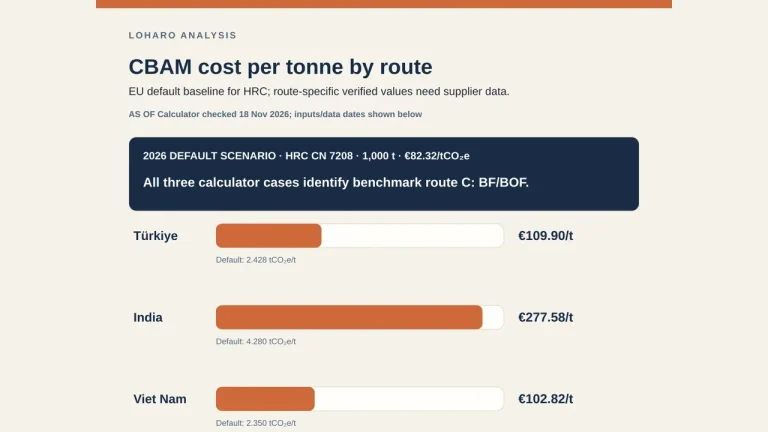
- Analysis CBAM: cold-rolled imports are also CBAM goods; anti-dumping duty and CBAM costs add up. See our per-tonne CBAM comparison for Indian coil.
Stay ahead of the steel market
What to watch
- Weekly Commission quota report (Fridays): India 09.9818 and Türkiye 09.9820 balances, in Loharo’s Tracker.
- Q1 2027 quota opening, 1 January: whether Japanese and Taiwanese quota stays unused once duties apply.
- Court challenges: exporters can challenge the regulation at the EU General Court; a court action does not by itself suspend the duty.
- New Taiwanese or Turkish exporters: Article 2 lets the Commission add new exporters at the cooperating rate.
Verification status: Verified
- Duty rates, scope, entry into force, the particular market situation findings and the refusal of retroactive collection are taken from Implementing Regulation (EU) 2026/2547 and the Commission’s 16 November announcement; investigation-year prices and volumes are Eurostat figures in the regulation; quota balances are from TARIC on 16 November. Per-tonne duties, price comparisons and quota shares are Loharo calculations with inputs shown.
- Key: Verified = material factual claims are supported by an appropriate primary source or clearly attributed reporting/market assessments; Partially verified = a specific material claim remains unsupported, contradicted or materially overstated; Analysis = interpretation or forecast with sourced premises; Developing = material facts are checked but the situation is still changing.
Sources
Primary sources
- Commission Implementing Regulation (EU) 2026/2547 of 13 November 2026 imposing a definitive anti-dumping duty on imports of certain cold-rolled flat steel products originating in India, Japan, Taiwan, Türkiye and Vietnam, Official Journal of the European Union, L series, 16 November 2026
- Commission imposes anti-dumping duties on certain cold-rolled flat steel products, European Commission, DG Trade and Economic Security, 16 November 2026
- Regulation (EU) 2026/1384 (steel tariff quotas and 50% out-of-quota duty), EUR-Lex
- TARIC tariff quota details, Q4 2026, last update 16 November 2026: 09.9818 India, 09.9820 Türkiye, 09.9822 Japan, 09.9817 Taiwan, 09.9707 FTA partners, 09.9602 other countries, European Commission
Supporting sources
- EU sets tariffs on steel from India, Japan, Taiwan, Turkey, Vietnam, Reuters via Nikkei Asia, 17 November 2026
- European CRC prices play by own rules, Kallanish via EUROMETAL, 13 November 2026
- Steel Trade Measures Tracker, Loharo (Commission report of 13 November 2026)
Last fact-check: 17 November 2026.
Planning steel imports into the EU? Estimate CBAM costs with the free calculator using EU default values. For supplier-specific emissions and a portfolio review, see the CBAM Cost Check.