From 1 January 2027 Norway and Iceland will charge CBAM on steel imported into their own customs territories, under the same rules as the EU. The European Commission’s customs and tax department (DG TAXUD) said on 18 November that EEA Joint Committee Decision No 283/2026 had entered into force that day, putting the CBAM Regulation into the European Economic Area agreement and creating a single “CBAM area” of the EU, Norway and Iceland. Liechtenstein stays outside (DG TAXUD; EEA Joint Committee decision). For most EU steel buyers nothing changes on 1 January. It does change things for companies that import into both the EU and Norway or Iceland, for Nordic traders selling into the EU, and for anyone who buys non-EEA steel from Norwegian stock.
What the decision changes
- One 50-tonne threshold for all three territories. The annual 50-tonne de minimis exemption for iron and steel, aluminium, cement and fertilisers will count an importer’s imports into the EU, Norway and Iceland together. Electricity and hydrogen stay in CBAM at any volume (DG TAXUD).
- Norwegian and Icelandic importers need declarant status. From 1 January 2027, importers there that go over the threshold, or their indirect customs representatives, must be authorised CBAM declarants. They apply through the CBAM Registry’s Authorisation Management Module before importing, with “certain flexibilities” for applications made by 31 March 2027 (DG TAXUD).
- Norway and Iceland stop being “third countries” for CBAM. Authorisations are recognised across the area, so a Norwegian importer can use its Norwegian authorisation to import into the EU without an indirect customs representative, and an EU importer can use its EU account in Norway (DG TAXUD).
- Two ID systems. Norway and Iceland use a Trader Identification Number (TIN), not EORI. Norwegian and Icelandic importers need an EORI number to import into the EU; EU companies importing into Norway or Iceland on an EU CBAM account need a TIN (DG TAXUD).
- Verifiers. Registration of verifiers accredited in Norway and Iceland starts on 1 December 2026 (DG TAXUD).
Norway’s Environment Agency said on 16 November that CBAM was taken into the EEA agreement on 25 September, Iceland has now lifted its constitutional reservations, and CBAM can apply in full in Norway from 1 January 2027. Norwegian Customs plans to open registration for a Norwegian ID number on 1 December 2026, provided Norway’s CBAM act and regulation come into force as planned, and every company importing CBAM goods into Norway must register whatever its volume. Between 1 January and 31 March 2027, importers may import without a granted authorisation if they applied before the import; this eases only the authorisation rule, not other CBAM duties (Miljødirektoratet; Tolletaten).
Reach steel buyers and importers worldwide
Put your brand in front of the people who buy and trade steel.
Advertise with LoharoOne thing does not change. Steel that originates in Norway or Iceland was already outside CBAM, because both countries are listed in Annex III of the CBAM Regulation as applying the EU emissions trading system (Regulation (EU) 2023/956, consolidated; DEHSt). A buyer of Norwegian-made bar or ferro-products has no new CBAM bill. The change is for goods from outside the EEA that pass through Norwegian or Icelandic customs.
Loharo table: which importer are you, and what to do before 1 January
| Your situation | What changes from 1 Jan 2027 | What to do now |
|---|---|---|
| EU importer, imports only into the EU | Nothing new. The 50 t threshold still counts only your EU imports | No action beyond your normal CBAM work |
| Same company imports CBAM goods into the EU and Norway or Iceland | Imports into all three now count towards one 50 t threshold | Add up 2027 tonnage across all three. If it could go over 50 t, plan for authorisation and get a TIN |
| Norwegian or Icelandic importer that also ships into the EU | No indirect customs representative needed for CBAM; one authorisation works across the area | Register with Norwegian Customs from 1 December; apply in the CBAM Registry before the first 2027 import (by 31 March 2027 for the transition); get an EORI number |
| EU buyer of Norwegian- or Icelandic-made steel | No change: these origins are outside CBAM (Annex III) | Keep the mill’s origin evidence on file |
| EU buyer of Asian or Turkish steel from a Norwegian stockholder | From 2027 the stockholder’s own imports into Norway carry CBAM | Ask whether 2027 offers include a CBAM cost, and on default or verified emissions |
Loharo calculation: the cost of crossing 50 tonnes
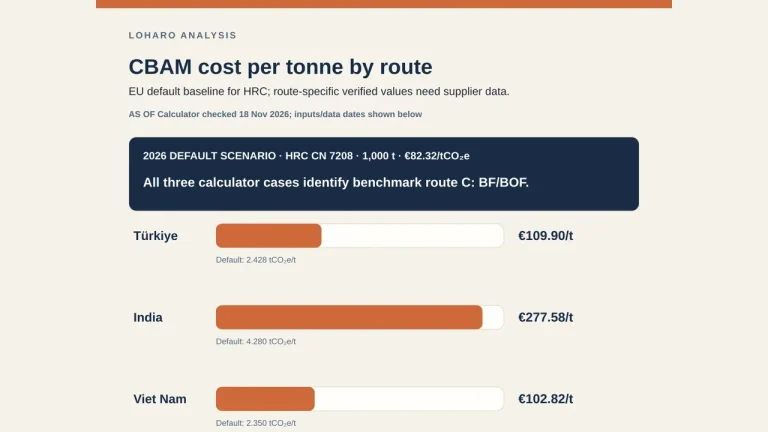
The threshold is a cliff, not an allowance. If an importer goes over 50 tonnes in a calendar year, every CBAM obligation applies to all goods it imported that year, from the first shipment (Article 2a(2); Regulation (EU) 2025/2083, recital 3). Joint counting makes this more likely for small importers that buy for both EU and Norwegian sites. The example below uses hot-rolled coil (CN 7208) at EU default values, priced per tonne by Loharo’s free CBAM calculator on 2026 parameters (10% default mark-up, 97.5% CBAM factor, Q3 2026 certificate price of €82.32): Türkiye €109.90/t, India €277.58/t.
| Importer’s yearly tonnage | In 2026 (EU counts alone) | In 2027 (EU + Norway count together) | CBAM, Türkiye HRC | CBAM, India HRC |
|---|---|---|---|---|
| 40 t into the EU only | Exempt | Exempt | €0 | €0 |
| 40 t into the EU + 10 t into Norway | Exempt (Norway had no CBAM) | 50 t, still exempt | €0 | €0 |
| 40 t into the EU + 11 t into Norway | Exempt | 51 t, all of it in scope | €5,605 | €14,157 |
| 40 t into the EU + 15 t into Norway | Exempt | 55 t, all of it in scope | €6,045 | €15,267 |
Read the table as a decision rule. If your combined EU and Norway/Iceland tonnage could pass 50 tonnes, the 51st tonne costs you CBAM on the first 50 as well. Either plan for the full cost and the declarant process, or keep the cross-border volume well below the line.
What Loharo has written before, and what is new
- Our 13 November piece on the 50-tonne exemption explained the threshold as it applies in the EU. What is new is that from 2027 it counts imports into Norway and Iceland too.
- Our CBAM timeline for 2026 to 2030 sets out the EU dates. Add two: 1 January 2027 for CBAM to start in Norway and Iceland, and 31 March 2027 for the authorisation flexibilities there.
- Our 18 November note on carbon-price deductions covers what happens when a carbon price has been paid abroad. Norway and Iceland are now inside the CBAM area, so that question does not arise for them.
What would change this view: Norwegian or Icelandic implementing rules that set different declaration or pricing details, or Commission guidance on how one importer’s tonnage is counted across the three customs territories.
Verification status: Verified
- The extension, threshold, authorisation, mutual-recognition, TIN/EORI and verifier dates come from DG TAXUD’s 18 November notice and the EEA Joint Committee decision. Norway’s start date, registration plans and transition rule come from Miljødirektoratet; Norway’s national CBAM act is still to come into force. The threshold rule and the Annex III origin exemption come from the CBAM Regulation and its 2025 amendment, with the German CBAM authority (DEHSt) as a cross-check. Per-tonne CBAM costs and the threshold scenarios are Loharo calculations on 2026 default parameters. The “what to do now” column is Loharo analysis.
- Key: Verified = material factual claims are supported by an appropriate primary source or clearly attributed reporting/market assessments; Partially verified = a specific material claim remains unsupported, contradicted or materially overstated; Analysis = interpretation or forecast with sourced premises; Developing = material facts are checked but the situation is still changing.
Sources
Primary sources
- Extension of CBAM to Iceland and Norway, European Commission, DG TAXUD, 18 November 2026
- Decision of the EEA Joint Committee No 283/2026 of 25 September 2026, EFTA
- CBAM: Ett steg nærmere oppstart, Miljødirektoratet (Norwegian Environment Agency), 16 November 2026 (Norwegian)
- CBAM: justering av karbonpris for importerte varer, Tolletaten (Norwegian Customs), checked 19 November 2026 (Norwegian)
- Regulation (EU) 2023/956, consolidated text, Article 2a and Annex III, EUR-Lex
- Regulation (EU) 2025/2083 amending the CBAM Regulation, EUR-Lex
Other sources
- Overview of CBAM obligations, DEHSt (German Emissions Trading Authority), checked 19 November 2026
- EU to extend CBAM to Norway and Iceland from January 2027, SteelOrbis, 19 November 2026
- Loharo Free CBAM Calculator (CN 7208, 2026 parameters), checked 19 November 2026
Last fact-check: 19 November 2026.
Planning steel imports into the EU? Estimate CBAM costs with the free calculator using EU default values. For supplier-specific emissions and a portfolio review, see the CBAM Cost Check.