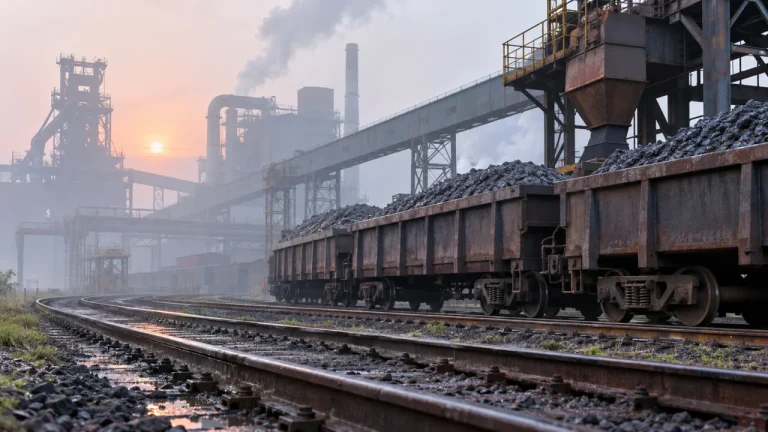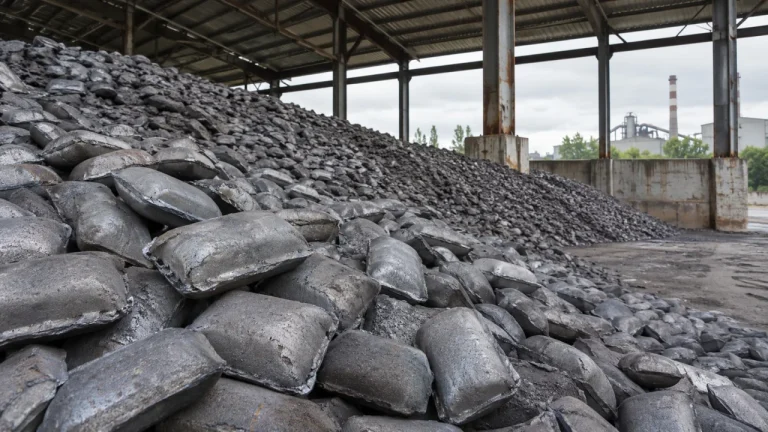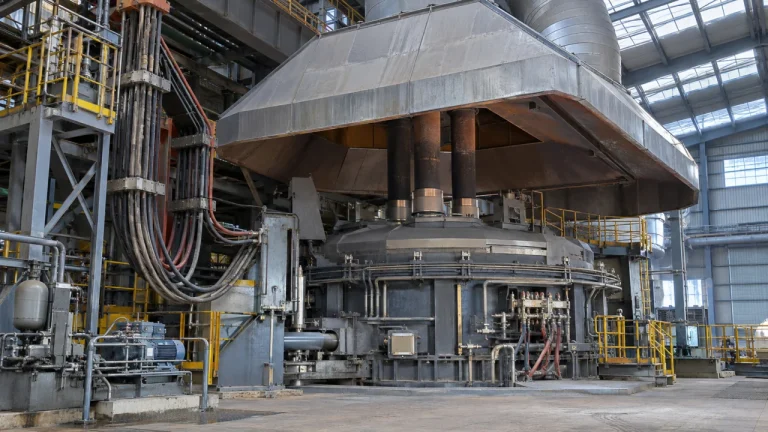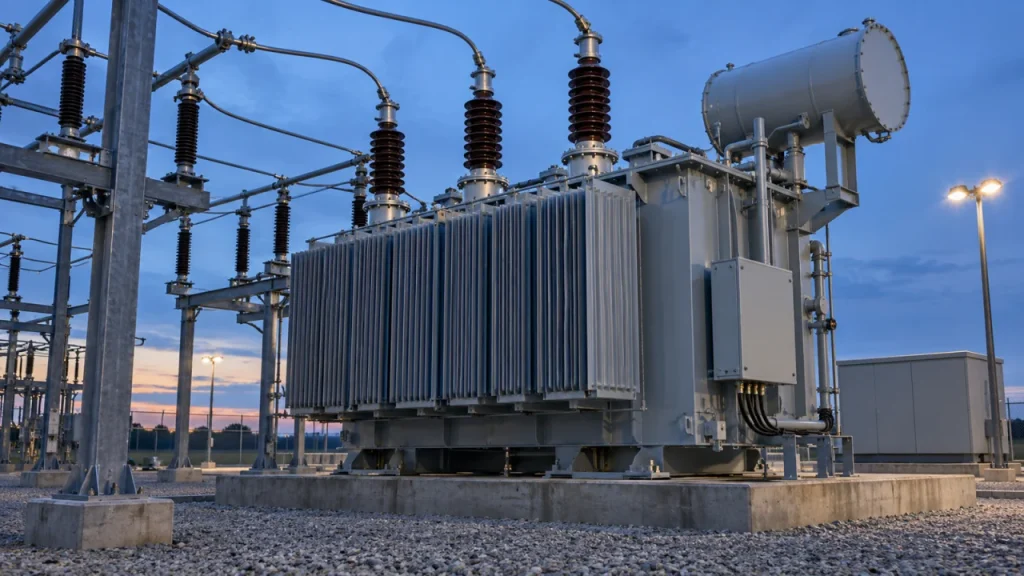
Feralpi’s electric-steel plant in Riesa, Saxony, has lost “some production days” to power-price spikes and its goal of making more than 1 million tonnes there for the first time this year is now at risk, general manager Uwe Reinecke told the Berliner Zeitung on 24 November (Berliner Zeitung). The plant stops its electric arc furnace by the hour when spot power passes an internal ceiling, even with orders in hand. Feralpi has not said how many days or tonnes were lost and has issued no statement of its own (Die Sachsen). For buyers of German construction steel, this is a supply-timing risk, not a shortage: confirm December and January rolling dates in writing, and expect most of the risk on cold, windless days. German day-ahead power for today, 27 November, averages about €302/MWh.
What Feralpi said
- Lost days, target at risk. “Through dark doldrums we have already lost some production days,” Reinecke said. The plant wanted to make more than 1 million tonnes in 2026, but “if I have to switch off the light more often, the target is at risk – despite a relatively good order book” (Berliner Zeitung).
- How the stops work. The furnace is built to run around the clock, but production stops by the hour when the exchange price passes a ceiling Feralpi does not disclose. Lost output cannot all be made up in cheaper hours, and staff costs continue.
- Why it buys spot. Much of the plant’s power is bought at short notice on the spot market, because customers often order only one and a half to two months ahead; committing to power earlier “would be like roulette”, Reinecke said.
- Not new, but worse. Feralpi began hourly stops in September, saying power prices and grid fees made production uneconomic in some hours (Ostdeutsche Zeitung, 19 September). What is new is the talk of lost days and of the 1 million-tonne target (Die Sachsen; marketSTEEL).
Feralpi has invested more than €220 million in Riesa, Reinecke said; about 900 jobs depend on the site, which makes construction steel from recycled scrap, according to the Ostdeutsche Zeitung. Like the steel association WV Stahl, Reinecke wants a capped power price: Germany is “still far” from 5 cents per kWh including grid fees and levies, he said, and the subsidy for transmission grid fees will be smaller in 2027 than in 2026 (Berliner Zeitung).
Reach steel buyers and importers worldwide
Put your brand in front of the people who buy and trade steel.
Advertise with LoharoWhat has changed since our 16 November report
On 16 November we worked out that Germany’s existing industrial power subsidy is worth only about €8–12 per tonne of electric-furnace steel, paid in 2027, and that day-ahead power had eased from about €275/MWh in 1–10 November to about €195–203/MWh (German steel summit asks for cheaper power). Since then, two things have changed. A German mill now says on the record that the spikes are costing it output. And power has climbed back: today’s day-ahead average is above the early-November level we used then. Bloomberg, cited by the Berliner Zeitung, put power for the next three months at about €200/MWh, roughly double last winter.
Loharo check: German day-ahead power and melting cost per tonne
We checked the reported spikes against the Federal Network Agency’s SMARD data for the Germany–Luxembourg zone (SMARD). In hourly values, 9, 10 and 11 November averaged €317–352/MWh, the only days above €300 between 9 and 25 November, and the highest hour was €644/MWh on 9 November. That matches the three days above €300 and the spikes above €600 reported via Bloomberg (single quarter-hours run higher than hourly values). Since 23 November prices have risen again.
| Period (2026) | Day-ahead average, €/MWh | Hours above €300 | Melting power at 450 kWh/t |
|---|---|---|---|
| 9–11 November | 337.92 | 44 of 72 | €152/t |
| 12–20 November | 187.76 | 0 of 216 | €84/t |
| 22–25 November | 236.24 | 8 of 96 | €106/t |
| 26 November | 291.76 | 13 of 24 | €131/t |
| 27 November (today) | 301.82 | 13 of 24 | €136/t |
| Highest hour, 9 November | 644.18 | — | €290/t |
Analysis. On these figures, an hour at today’s average costs a scrap-based mill about €50 a tonne more in melting power than an hour in 12–20 November, and the 9 November peak hour about €200 a tonne more. That is why a mill buying spot power stops for the expensive hours rather than running through them. The stops matter more for buyers when the cheap hours in between also get dearer, as they did this week. Energy economist Lion Hirth told the Berliner Zeitung that single stops are no threat to industrial output, but that in a long, cold dark doldrums it could make sense for some plants to pause for days or even weeks.
What this means for buyers
Feralpi has given no delivery warning, and Riesa has not said how much output it lost, so treat this as a timing risk on construction steel from German electric mills, not a shortage. Italian long-product mills face the same pressure: Pittini stops Verona and Potenza for a week from 30 November (our 18 November report).
If you buy from Riesa or other German electric mills, get December and January rolling and delivery dates confirmed in writing, and ask whether any energy surcharge in your contract follows spot power. Expect the highest risk of short stops on cold, windless days.
Stay ahead of the steel market
What to watch
- Whether Feralpi gives a figure for lost days or tonnes, or says Riesa will miss 1 million tonnes in 2026.
- German day-ahead prices on SMARD for the next cold, windless spell, and whether averages stay above €300/MWh for several days in a row.
- Any change to the 2027 transmission-grid fee subsidy, and the first payments under the industrial power price, due to be applied for from January 2027.
Verification status: Verified
- Feralpi’s lost days, the at-risk 1 million-tonne target, its hourly stops and spot buying come from general manager Uwe Reinecke’s comments to the Berliner Zeitung, also reported by marketSTEEL and Die Sachsen; Feralpi has issued no statement of its own and has not quantified the losses. The September start of hourly stops is from the Ostdeutsche Zeitung. The power prices are Loharo’s check of official SMARD data; the per-tonne figures are a Loharo calculation with the inputs shown.
- Key: Verified = material factual claims are supported by an appropriate primary source or clearly attributed reporting/market assessments; Partially verified = a specific material claim remains unsupported, contradicted or materially overstated; Analysis = interpretation or forecast with sourced premises; Developing = material facts are checked but the situation is still changing.
Sources
Primary sources
- Berliner Zeitung (Flynn Jacobs), “Strompreis schießt über 600 Euro: Ostdeutsches Stahlwerk muss den Ofen abstellen – trotz Aufträgen”, 24 November 2026 (comments by Feralpi Stahl general manager Uwe Reinecke)
- SMARD (Bundesnetzagentur), day-ahead wholesale prices, Germany–Luxembourg, hourly values for 9–27 November 2026, read 27 November 2026
Supporting sources
- marketSTEEL, “Strompreisspitzen zwingen FERALPI STAHL zu Produktionsstopps”, 25 November 2026
- Die Sachsen (Meißen News), “Riesa: Feralpi verliert Produktionstage durch hohe Strompreise”, November 2026
- Ostdeutsche Zeitung (Christian Richter), “Stromkosten setzen Stahlwerk in Riesa unter Druck – Feralpi stoppt Produktion stundenweise”, 19 September 2026
- Journal of Sustainable Metallurgy, “The Influence of Electric-Arc-Furnace Input Feeds on its Electrical Energy Consumption”, 2021
- DFIU/University of Karlsruhe for the German Federal Environment Agency (UBA), “Report on Best Available Techniques (BAT) in the Electric Steelmaking Industry”, 1997, Table 3-1
- Loharo, “German steel summit asks for cheaper power”, 16 November 2026
- Loharo, “Pittini will stop its Verona and Potenza mills for a week from 30 November”, 18 November 2026
Last fact-check: 27 November 2026.
Planning steel imports into the EU? Estimate CBAM costs with the free calculator using EU default values. For supplier-specific emissions and a portfolio review, see the CBAM Cost Check.