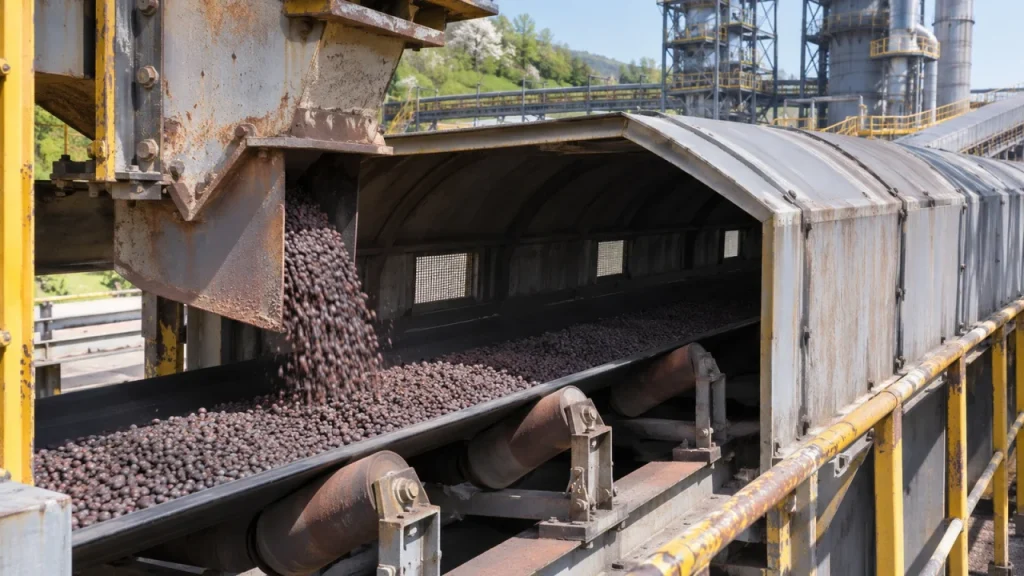
thyssenkrupp Steel’s new direct reduction plant in Duisburg is now due to start in 2029, not 2027, according to a European Commission state aid document first reported by Politico; a company spokesperson confirmed the delay to the German news agency dpa (Handelsblatt/dpa). For EU buyers of flat steel, this means no low-CO₂ steel from the new plant before 2029. If you are negotiating low-CO₂ hot-rolled, cold-rolled or coated coil from thyssenkrupp for 2027 or 2028, ask now which plant and route it will come from and which certified CO₂ figure per tonne you will get, because it cannot come from the new plant.
What has changed
According to the Commission document, as reported by Eurometal and SteelOrbis, the Commission linked the two-year delay to construction challenges arising from the project’s innovative nature. The company spokesperson said the delay comes mainly from the engineering phase and that the ramp-up will closely follow the market and the availability of hydrogen. Eurometal reports that thyssenkrupp does not expect extra project costs from the delay and has not yet announced an exact commissioning date.
Reach steel buyers and importers worldwide
Put your brand in front of the people who buy and trade steel.
Advertise with LoharoThe amended aid decision also changes how the money is paid, according to MEsteel’s account of the decision, the only report Loharo found with these details. The maximum aid stays at €2 billion, but it is now paid entirely as a direct grant. In 2023 it was a grant of up to €550 million plus up to €1.45 billion in conditional payments for using renewable hydrogen. MEsteel says the Commission gave three reasons: higher expected costs for low-carbon hydrogen and electricity, and lower expected carbon allowance prices. Hydrogen will be phased in more gradually and at a lower level, with more natural gas at first.
The plant itself is unchanged: 2.5 million tonnes a year of direct reduced iron and two melting units for 2.3 million tonnes of hot metal, replacing one blast furnace without adding output, SteelOrbis reports.
Loharo reconciliation: three start dates for one plant
| Source | What it says about the start | Status |
|---|---|---|
| European Commission, 20 July 2023 | New installations “envisioned to start operating in 2026” | Superseded |
| thyssenkrupp project site, read 12 November 2026 | Commissioning of the DR plant “starts in 2027” (in German) | Not yet updated |
| Commission document, as reported by Transformer Magazine and Eurometal, 9 November 2026 | Start of operations in 2029 instead of 2027 | Confirmed by thyssenkrupp’s spokesperson |
Analysis The 2026 date in 2023 and the 2027 date on the project site are both now out of date. Our report of 2 November used the project site’s 2027 date, which the company has since confirmed has moved to 2029.
Loharo calculation: what the plant saves per tonne, on gas and on hydrogen
| Input or result | Value | Basis |
|---|---|---|
| Hot metal from the new route | 2.3 Mt a year | SteelOrbis; Commission, 2023 |
| CO₂ saving on natural gas (original plans) | about 1.9 Mt CO₂e a year | MEsteel |
| CO₂ saving at full hydrogen | up to 3.5 Mt a year | thyssenkrupp, via Eurometal |
| Saving per tonne of hot metal, natural gas | 1.9 ÷ 2.3 = about 0.8 t CO₂e | Loharo calculation |
| Saving per tonne of hot metal, full hydrogen | 3.5 ÷ 2.3 = about 1.5 t CO₂ | Loharo calculation |
Analysis On these figures, steel from the natural gas stage would save about half as much CO₂ per tonne as the full-hydrogen stage. With hydrogen now phased in more slowly, the gas stage is likely to last longer, so buyers should expect the first steel from the plant after 2029 to carry the gas-stage saving, not the hydrogen one, and price any premium on that basis.
What it means for your contracts
Analysis If a supply agreement refers to steel from the Duisburg direct reduction plant, or to hydrogen-based steel, from 2027 or 2028, check its start-date clause and what happens if the source plant is late. For any low-CO₂ premium before 2029, ask for a certified CO₂ figure per tonne of the product and the method behind it, and tie the premium to that figure. thyssenkrupp’s own site says its hot-rolled steel currently holds class D under the German LESS low-emission steel label, with class A the aim once bluemint products and hydrogen are used. If your contract needs a better class than D before 2029, ask how it will be met.
Stay ahead of the steel market
What to watch
- Coming weeks: the start of thyssenkrupp’s new hydrogen supply tender, which it said on 30 October would begin shortly (thyssenkrupp Steel).
- Publication of the amended decision in the Commission’s state aid register, which would show the conditions now attached to the €2 billion grant.
- December 2026: the European Parliament’s planned plenary vote on low-carbon steel credits for carmakers (SteelOrbis), which could add demand for low-CO₂ flat steel from EU mills.
- For how the gas-DRI route compares with blast furnace and scrap-EAF steel, see our route comparison.
Verification status: Verified
- The 2029 start date comes from a Commission document reported by Politico, dpa, Eurometal and SteelOrbis, and thyssenkrupp’s spokesperson confirmed it. The aid restructuring and the Commission’s reasons come from one report, MEsteel, and are attributed to it; Loharo could not read the amended decision itself. The tables are Loharo calculations and reconciliations, with inputs shown.
- Key: Verified = material factual claims are supported by an appropriate primary source or clearly attributed reporting/market assessments; Partially verified = a specific material claim remains unsupported, contradicted or materially overstated; Analysis = interpretation or forecast with sourced premises; Developing = material facts are checked but the situation is still changing.
Sources
Primary sources
- State aid: Commission approves German €550 million direct grant and conditional payment mechanism of up to €1.45 billion (IP/23/3928), European Commission, 20 July 2023
- Definitive grant notice strengthens the ongoing tkH2Steel decarbonization project, thyssenkrupp Steel, 30 October 2026
- Transformation zu klimaneutralem Stahl (project site, in German), thyssenkrupp Steel, read 12 November 2026
Supporting sources
- Wasserstoff statt Kohle: Start einer Produktionsanlage für Grünstahl verzögert sich (in German), Handelsblatt/dpa, 6 November 2026
- thyssenkrupp postpones commissioning of Duisburg DRI plant to 2029, Eurometal, 9 November 2026
- thyssenkrupp delays Duisburg plant to 2029, Transformer Magazine, 9 November 2026
- Thyssenkrupp delays Duisburg DRI plant start-up to 2029, SteelOrbis, 10 November 2026
- Thyssenkrupp revises timeline for Duisburg DRI project, MEsteel, 11 November 2026
- European Parliament committee approves low-carbon steel credits for carmakers, EUROFER welcomes decision, SteelOrbis, 6 November 2026
Last fact-check: 12 November 2026.
Planning steel imports into the EU? Estimate CBAM costs with the free calculator using EU default values. For supplier-specific emissions and a portfolio review, see the CBAM Cost Check.